
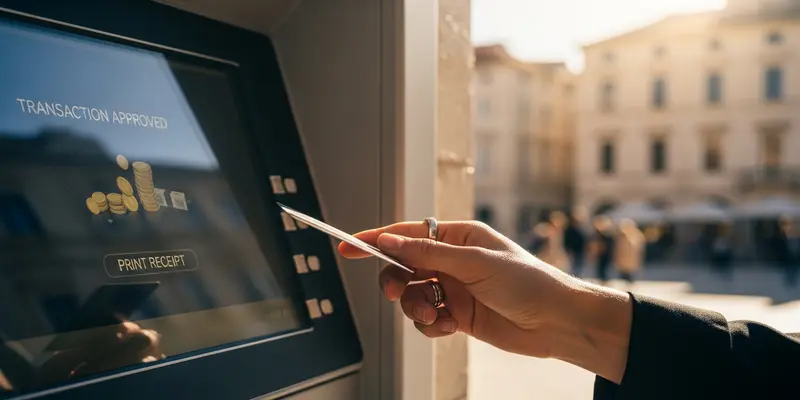
You are standing in a dimly lit alcove in a foreign city, jet-lagged and desperate for cash. The ATM screen blinks a polite, seemingly helpful question: "Would you like to accept our conversion rate for your convenience?" It shows you a nice, round number in your home currency. It looks safe. It looks certain.
It is a scam.
Every time you choose to Withdraw Without Conversion, you are winning a small war against predatory banking. This practice, known in the industry as Dynamic Currency Conversion (DCC), is a legalized mugging designed to exploit your fear of fluctuating exchange rates.
The Guaranteed Rate is a Lie
Banks frame the conversion option as a service. They use words like "guaranteed," "fixed," and "zero commission." Don’t believe them. When you allow the ATM’s bank to do the math, they aren’t using the mid-market rate you see on Google. They are using a proprietary rate that includes a massive markup—often between 7% and 13%.
By selecting "Withdraw Without Conversion," you are telling the local machine: "Just give me the local cash and let my bank at home handle the math." Your bank at home almost certainly uses the Visa or Mastercard wholesale rate, which is the closest thing to a fair price you’ll ever get.
Why Your Bank is the Better Partner
- Transparency: Your home bank is regulated by your local laws.
- Wholesale Pricing: Large card networks process billions in transactions; they get the best rates.
- Consistency: You won’t have to guess which ATM is "fairer" because you’re bypassing their software entirely.
The Cost of a Single Click
I learned this lesson the hard way in a rain-slicked alleyway in Prague. I was rushing to pay for a late-night dinner and didn’t want to think. I hit "Accept Conversion" on a 5,000 Koruna withdrawal. The ATM charged me roughly $245.
The next morning, nursing a strong coffee and a sense of regret, I checked the actual exchange rate. If I had simply chosen to be billed in local currency, the charge would have been $218. I effectively paid $27 for the "convenience" of seeing the dollar sign on a screen for three seconds. That $27 could have bought another three rounds of world-class Czech pilsner. Since that night, I have never let an ATM make a decision for me again.
How to Win the ATM Game
- Always choose local currency: If the machine asks if you want to be charged in Dollars/Pounds/Euros (your home currency), say NO.
- Look for the ‘Decline’ button: Sometimes the machine will ask if you want to "Continue with Conversion" or "Continue without Conversion." Always choose the latter.
- Use a travel-friendly bank: Cards like Charles Schwab or Wise often reimburse ATM fees entirely, making the local rate even sweeter.
Choosing to Withdraw Without Conversion isn’t just about the money; it’s about the principle. It’s about refusing to be the easy target in a tourist trap. Travel is expensive enough—don’t give the banks a tip they didn’t earn.
FAQs
Q: What happens if I click ‘Decline Conversion’?
A: Nothing bad. The ATM will still give you the cash you requested, but it will bill your bank in the local currency rather than your home currency.
Q: Why does the ATM make ‘Accepting’ look like the better option?
A: Psychology. They use green buttons for "Accept" and red for "Decline" to trick your brain into thinking declining is a mistake or a cancellation.
Q: Is this the same as the ATM’s ‘Access Fee’?
A: No. An access fee is a flat charge (e.g., $5) to use the machine. Conversion is a percentage-based markup on the exchange rate itself. You want to avoid both if possible, but the conversion is usually the more expensive trap.
Q: Does this apply to credit card machines in shops?
A: Absolutely. If a waiter or shopkeeper asks if you want to pay in your home currency, always insist on the local currency.
Q: Is the ‘Withdraw Without Conversion’ option always available?
A: By law in most regions (including the EU), they must offer you the choice, though they often hide it behind confusing wording.
Q: How much can I actually save?
A: On a typical two-week trip, a savvy traveler can save anywhere from $50 to $200 just by consistently choosing the local currency option at ATMs and card terminals.