
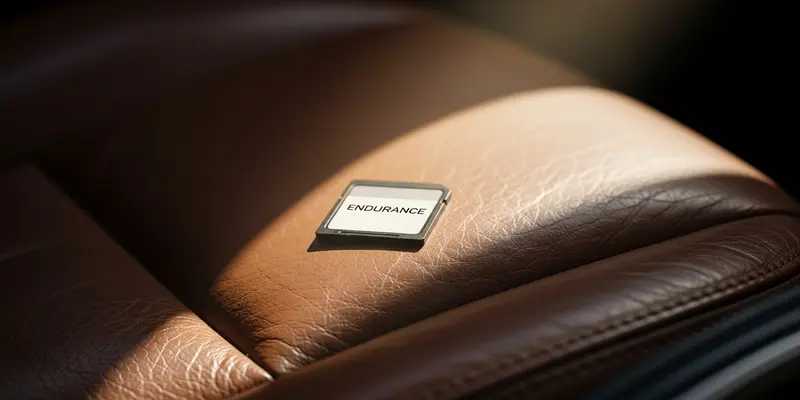
You’re driving home. A car cuts you off. Metal crunches. You feel safe because that little blue light on your dashcam has been blinking faithfully all month. But when you pull the card to show the police, the screen displays a cold, mocking message: "File Corrupt." This isn’t a glitch. It’s the inevitable result of using cheap, standard memory instead of Endurance SD cards.
The Silent Death of the Oxide Layer
Most people think an SD card is a bottomless digital bucket. It’s not. It’s more like a physical ledger that can only be written on and erased a certain number of times before the paper tears. In technical terms, every write cycle physically degrades the card’s oxide layer.
Standard SD cards are designed for cameras or phones where you take a photo, save it, and leave it. A dashcam or security camera is a different beast. It writes, erases, and rewrites high-definition video data every single second you are on the road. This constant friction burns through a standard card’s lifespan in months, leading to catastrophic failure exactly when you need the footage most.
Why Speed Ratings Are a Marketing Trap
You see "Class 10" or "U3" and think you’re protected. You aren’t. Those are speed ratings, not durability ratings. A fast card can still be a fragile one.
Cheap cards often use QLC (Quad-Level Cell) flash memory. It’s dense and inexpensive, but it’s the glass cannon of the storage world. High-endurance cards use MLC (Multi-Level Cell) or specially tuned TLC tech. They are built to withstand the relentless loop-recording cycle and the extreme temperature swings of a parked car in July or a frozen driveway in January.
The Day My $15 Saving Cost Me $500
I learned this the hard way on a rainy Tuesday in Seattle. A delivery van backed into my front bumper while I was parked. I saw it happen from across the street. I wasn’t even worried—I had a brand-new 128GB ‘Ultra’ card in my dashcam.
When I got to my car and checked the footage, the file for that specific ten-minute window was a 0KB ghost. The card had reached its write-limit and ’locked’ itself into read-only mode ten miles before the accident. I couldn’t prove a thing. That $15 I saved by buying the ‘budget’ card ended up costing me a $500 insurance deductible. The smell of wet asphalt and the sinking feeling in my gut that day is why I now tell everyone: do not trust your safety to a bargain bin chip.
How to Buy the Right Card
Don’t just look for capacity. Look for the ‘Endurance’ branding. Here is your checklist:
- Total Terabytes Written (TBW): Check the specs for the TBW rating. The higher, the better.
- Warranty: If the manufacturer excludes dashcam use from the warranty, stay away.
- Operating Temperature: Ensure it is rated for at least -25°C to 85°C.
- Brand Reputation: Stick to lines specifically labeled for surveillance, like the Samsung Pro Endurance or SanDisk Max Endurance.
Conclusion
Your dashcam is a witness, but a witness is useless if they have amnesia. Stop treating your memory card as a disposable commodity. Investing in a high-endurance card isn’t just about tech specs; it’s about ensuring that when the worst happens, you have the proof to walk away clean. Go to your car, eject that cheap card, and replace it today.
FAQs
Q: Can I use a standard 512GB card instead of a 64GB endurance card? No. While a larger card lasts longer because the writes are spread out, standard cards still lack the robust oxide layer and heat resistance of true endurance models.
Q: How long does a high-endurance SD card usually last? Most are rated for 5,000 to 20,000 hours of continuous recording, which usually equates to 3-5 years of heavy use.
Q: Why does my dashcam say ‘Memory Error’ even with a new card? If it’s a standard card, the dashcam’s controller might be rejecting it because the write speeds are inconsistent, or the card has already failed its first few cycles.
Q: Does formatting the card regularly help? Yes. Formatting every 30 days helps the card’s controller manage ‘wear leveling’ and keeps the file system clean.
Q: Are expensive cards always high-endurance? No. Many expensive ‘high-speed’ cards for professional photography have very low endurance ratings. Always look for the ‘Endurance’ or ‘Surveillance’ label.
Q: Is 4K recording harder on SD cards? Absolutely. 4K video generates more heat and writes significantly more data per second, making a high-endurance card mandatory, not optional."