
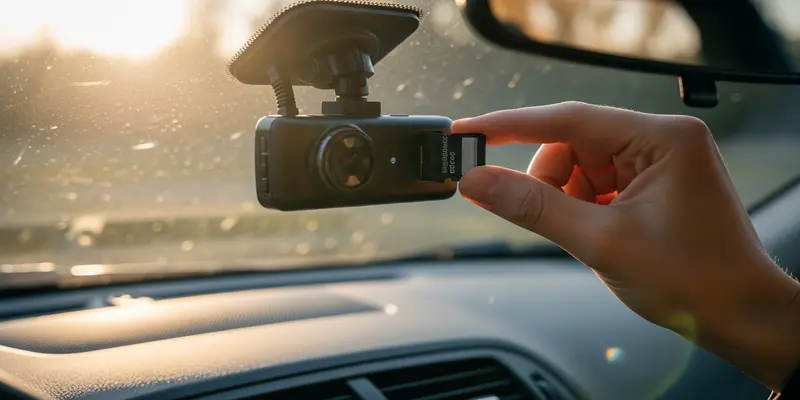
You’ve just spent $300 on a top-of-the-line 4K dashcam. You feel invincible, like you’ve finally bought an insurance policy against the chaos of the road. But if you popped in that spare "Extreme" or "Ultra" SD card you had lying around from your old DSLR, you’ve built your house on sand. It is time to Stop Using Standard SD Cards before a car accident turns into a legal nightmare.
Dashcams are not cameras; they are data-shredding machines. Unlike a GoPro that records a vacation once a month, a dashcam is a relentless beast, writing, erasing, and overwriting data every second the engine is running. Standard SD cards simply aren’t built for this industrial-level abuse.
The Lethal Cycle of "Write Exhaustion"
Memory cards have a finite lifespan measured in write cycles. A standard card is designed for the occasional burst of photos or a video clip. In a dashcam, that card is hitting its write limit at lightning speed. Within months, the memory cells begin to fail.
- Loop Recording: Dashcams overwrite the oldest footage constantly.
- Heat Sensitivity: Windshields act as magnifying glasses; cheap cards bake and warp.
- Voltage Fluctuations: Constant power cycling during engine starts can corrupt a weak controller.
When a standard card fails, it doesn’t always tell you. It might show a green light while recording absolutely nothing, leaving you with a blank screen when you need evidence the most.
Why "High Endurance" Isn’t Marketing Fluff
High Endurance cards use a different type of internal architecture, often utilizing MLC (Multi-Level Cell) or specially tuned TLC (Triple-Level Cell) NAND flash. These are the marathon runners of the silicon world. They are specifically engineered to handle thousands of hours of continuous recording and the extreme temperature swings of a parked car in July.
If the card doesn’t explicitly say "High Endurance" on the label, it belongs in your Nintendo Switch or your point-and-shoot, not your dashboard. Buying a regular card for a dashcam is like bringing a marathon runner’s shoes to a wildfire.
The Day the Footage Disappeared
I learned this the hard way through my friend, Leo. Leo is a stickler for gadgets. He had a 4K dashcam and a "Gold" rated 128GB card he’d salvaged from his drone. He thought he was set.
Last November, a distracted driver swerved into his lane, clipping his front fender before speeding off. Leo felt a surge of relief—he had the plate on camera. Or so he thought. When we pulled the card in my driveway, the file from the time of the accident was a 0kb ghost. The card had reached its write limit three weeks prior and had simply stopped saving new data. The dashcam’s "Record" light was on, but nobody was home. That $20 savings on a cheap card cost him a $1,000 deductible.
How to Choose the Right Shield
Don’t just look at the brand. Look at the specs. Your dashcam reliability depends on three specific markers:
- Endurance Rating: Look for a card rated for at least 5,000 to 10,000 hours of recording.
- U3 / V30 Speed Class: This ensures the card can keep up with the high bitrate of 4K video without dropping frames.
- Warranty: Manufacturers often void the warranty of standard cards if they are used in a dashcam. High Endurance cards carry a specific warranty for this use case.
The Final Verdict
A dashcam is an emergency tool. You don’t buy a fire extinguisher filled with confetti because it was cheaper. Stop gambling with your road safety. Invest the extra $15 into a legitimate High Endurance card today. Your future self will thank you when the unthinkable happens.
FAQs
Q: Can I use a high-speed ‘Extreme’ card instead? No. Speed is not the same as endurance. An ‘Extreme’ card is fast at writing once, but it will wear out just as quickly as a basic card under continuous loop recording.
Q: How often should I format my dashcam SD card? Even with a High Endurance card, you should format it once a month inside the camera. This clears out corrupted file fragments and keeps the file system healthy.
Q: Does card capacity matter for endurance? Yes. Larger cards (like 128GB or 256GB) last longer because the camera has more ‘room’ to write before it has to overwrite the same physical memory cell again.
Q: Why did my dashcam stop recording suddenly? It is likely ‘Card Error’ or ‘Write Speed’ failure. Most dashcams have a fail-safe that stops recording if the card can no longer keep up with the data stream due to cell degradation.
Q: Are all High Endurance cards the same? Mostly, but stick to reputable brands like SanDisk, Samsung, or Transcend. These companies manufacture their own NAND flash, ensuring better quality control.
Q: Will a High Endurance card make my video quality better? Not directly, but it prevents ‘artifacting’ and ‘stuttering’ caused by the card struggling to write data, resulting in a much smoother, reliable playback.