
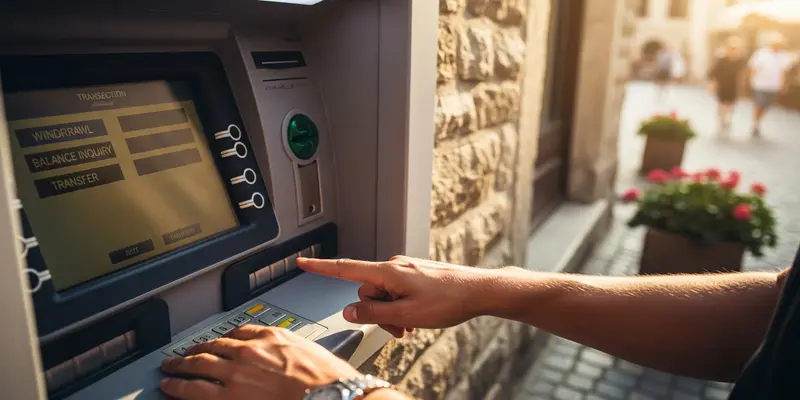
You’re standing in a bustling plaza in Rome, the scent of espresso in the air, and you realize you need cash for that hidden-gem trattoria. You find an ATM, slide in your card, and suddenly the screen asks a confusing question: "Would you like to be charged in your home currency or the local currency?" It looks like a courtesy. It feels like safety. But in reality, it’s a calculated ambush known as dynamic currency conversion.
Most travelers see their home currency (USD, GBP, CAD) and feel a sense of relief. They hit "Accept" because they want to know exactly what’s leaving their account. Don’t fall for it. You are walking straight into a fee trap that can cost you 5% to 15% of your total withdrawal.
The Illusion of Convenience
Dynamic Currency Conversion (DCC) is a service offered by the ATM provider, not your bank. When you accept their conversion, the ATM owner sets the exchange rate. Unsurprisingly, they set it to favor their bottom line, not yours. They’re banking on your fear of the unknown.
- The Mark-up: Most ATMs use a predatory rate far worse than the mid-market rate.
- Hidden Fees: On top of a bad rate, they often tack on a convenience fee for the "service" of doing the math for you.
- Double Dipping: Your home bank might still charge a foreign transaction fee anyway.
Why ‘Decline’ is the Only Choice
When you select "Decline Conversion" or "Charge in Local Currency," you are telling the ATM to let your home bank handle the math. Your home bank—whether it’s Chase, Monzo, or Charles Schwab—almost always uses the Visa or Mastercard wholesale rate. This rate is the gold standard. It’s fair, transparent, and significantly cheaper than whatever the sketchy machine in the airport is offering.
Choosing the local currency puts the power back in your hands. It’s the difference between paying for a nice dinner and literally handing your money to a corporation for no reason.
The $20 Taco Lesson
I learned this the hard way in Mexico City. I was starving, tired from a long flight, and desperately needed pesos for a street food tour. I used a flashy ATM near the Zócalo. The screen offered me a rate that seemed "fine." I was withdrawing about $200 USD worth of pesos. I hit "Accept" without thinking.
Later that night, I checked my banking app. Between the terrible exchange rate and the DCC fee, I had paid nearly $22 extra for that single withdrawal. That was the price of four artisan tacos and two beers gone in a single click. Now, no matter how tired I am, I look for the "Decline" button like my life depends on it. Because in the world of travel, every dollar saved is another mile gained.
How to Outsmart the Machine
The ATM will try to scare you. It might use red text or warnings like "Transaction may be subject to additional fees if you decline." Ignore the noise.
- Step 1: Insert card and enter PIN.
- Step 2: Select the amount in local currency.
- Step 3: When the DCC screen appears, look for "Decline Conversion" or "Proceed without conversion."
- Step 4: Collect your cash and enjoy the better rate.
Taking Control of Your Travel Budget
Travel should be about experiences, not about being a piggy bank for foreign ATM networks. By understanding this one simple trick, you protect your hard-earned money. It’s a small victory, but those small victories add up to extra days on the road and better stories to tell.
Stop being a passive consumer. Be an intentional traveler. The next time that screen flashes a "helpful" conversion, look it in the eye and hit decline. You’ve earned that money—keep it.
FAQs
Q: What is Dynamic Currency Conversion (DCC)? A: It is a process where a foreign ATM or merchant offers to convert a transaction into your home currency on the spot, usually at a very poor exchange rate.
Q: Why is it better to decline the conversion? A: Declining allows your home bank to handle the conversion using the standard Visa/Mastercard exchange rate, which is almost always significantly better than the ATM’s rate.
Q: Will the ATM still give me cash if I decline? A: Yes. Declining the conversion doesn’t cancel the withdrawal; it just cancels the ATM’s specific (and expensive) exchange rate service.
Q: Does this apply to credit card readers in shops too? A: Absolutely. Always choose to pay in the local currency at restaurants and stores to avoid the same predatory markups.
Q: How much can I save by declining? A: Usually between 3% and 12% per transaction, depending on the ATM provider’s specific greed level.
Q: Are there any ATMs that don’t offer DCC? A: Some bank-owned ATMs are better than others, but DCC is becoming standard. Your best defense is always choosing the local currency regardless of the machine type.