
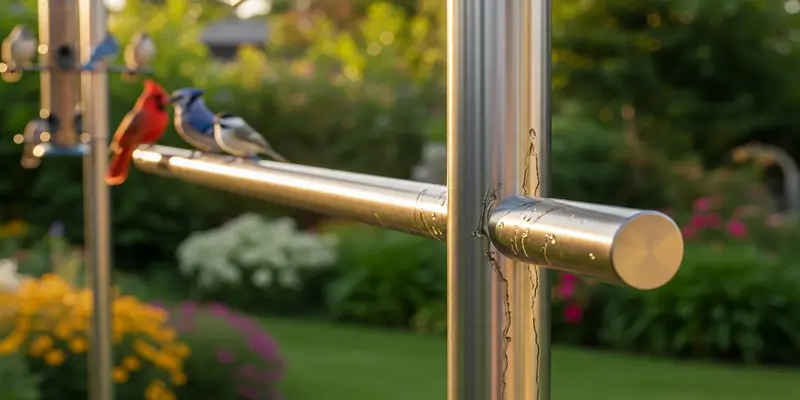
Imagine you have just spent twenty dollars on a premium, sunflower-heavy seed mix, only to watch a furry acrobat hang upside down and dump the entire tray onto the lawn in three minutes flat. Most gardeners struggle with squirrels stealing birdseed, and the industry knows it. They will sell you expensive baffles, weighted perches, and electrified wires that rarely work for long.
Stop throwing money at plastic gadgets. The most effective way to squirrel-proof your bird feeder pole is not found at a hardware store; it is sitting right in your kitchen pantry. We are taking a stand against over-engineered solutions in favor of something that actually works: friction—or the total lack of it.
The Expensive Myth of the Squirrel Baffle
Commercial squirrel baffles are often a joke. These plastic domes crack in the sun, fill with debris, and eventually provide a convenient ledge for a determined rodent to launch itself from. A squirrel’s grip is its greatest asset, and most “proofed” poles still offer enough texture for their claws to find purchase.
Instead of trying to block them with physical barriers, we need to make the climb physically impossible. By using a non-toxic lubricant, we turn the climb into a comedy routine. It is cheap, effective, and takes less than two minutes to apply.
Your Secret Weapon: Vegetable Shortening
Forget the WD-40 or industrial grease—those are toxic and have no place in a backyard habitat. Reach for a tub of vegetable shortening, like Crisco, or a high-viscosity cooking oil.
- Vegetable Shortening: This is the gold standard because it stays thick and doesn’t run off in the heat.
- The Application: Wipe the pole clean of any dirt or grit first. Then, apply a thin, invisible layer from the mid-point of the pole all the way to the top.
- The Science: Squirrels rely on a tight squeeze-and-climb mechanic. On a greased pole, they simply can’t generate the upward force needed to overcome gravity.
The Day the Acrobat Met His Match
I used to have a squirrel I nicknamed “Lebron” because of his incredible vertical jump. I had tried every cage and “weight-sensitive” feeder on the market. Lebron would simply hang by one toe and scoop the seeds out with his tiny, dexterous hands, looking me dead in the eye through the window.
One Saturday, I took a handful of shortening and smeared that metal pole until it shone like a new nickel. Five minutes later, Lebron arrived. He took his usual confident leap, hit the pole at the four-foot mark, and—I kid you not—slid down like a cartoon character on a banana peel. The look of utter confusion on his face as he hit the grass was the most satisfying moment of my gardening life. He tried three more times before giving up for good.
Maintenance for a Bird-Friendly Yard
Because this method uses food-grade materials, it is completely safe. If a squirrel licks its paws, it’s just getting a bit of vegetable fat. It won’t harm the birds, as they land on the wooden perches or the feeder itself, not the pole.
You will need to reapply the coating after a heavy rainstorm or roughly every two weeks during the peak season. It is a small price to pay for the peace of mind that your expensive seed is actually reaching the birds you love.
FAQs
Q: Will the oil hurt the birds? A: No. Birds land on the feeder or perches. They do not cling to the pole like squirrels do, so they rarely come into contact with the oil.
Q: Does this work on wooden poles? A: It is less effective on wood because the oil tends to soak into the grain. Metal or PVC poles are the best candidates for this hack.
Q: Will it attract ants to the feeder? A: Usually, no. Ants are attracted to sugars and proteins. Pure vegetable shortening is a fat and typically doesn’t interest them.
Q: Can I use motor grease instead? A: Absolutely not. Motor grease is toxic to animals and can ruin their fur or feathers. Always use food-grade kitchen oils.
Q: How high up should I grease the pole? A: Start about three feet from the ground and go all the way to the feeder base. Squirrels can jump surprisingly high from a standing start.
Q: Does cold weather affect the effectiveness? A: Shortening actually works better in the cold as it hardens slightly, maintaining a very slick, waxy surface that is impossible to grip.