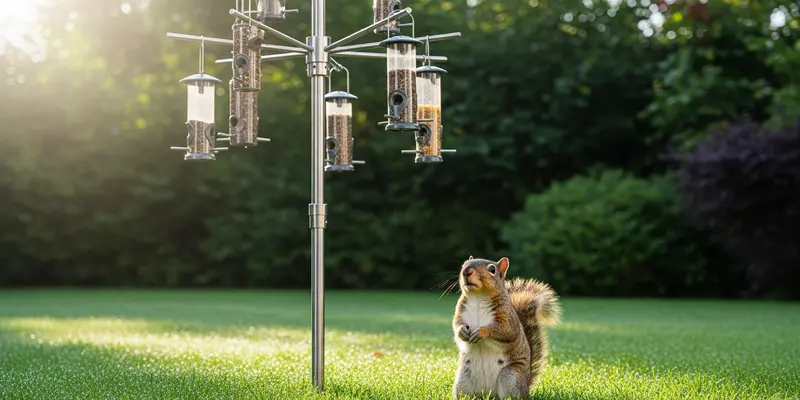
You’ve spent twenty dollars on the good sunflower seeds. You’ve curated the perfect backyard sanctuary. You sit down with your morning coffee, ready to watch the cardinals, only to find a fuzzy, tail-flicking acrobat hanging upside down, gorging himself while the birds wait in the wings. It feels personal. It feels like a heist. If you are tired of watching your birdseed budget vanish into the bellies of rodents, it is time to stop playing fair. The secret isn’t a complex trap; it’s a simple, food-safe strategy for squirrel-proofing your backyard bird feeders using physics.
The Problem with Typical Defenses
Most people start with ‘squirrel-proof’ feeders. These are usually expensive contraptions with weight-sensitive perches. They work—until they don’t. Squirrels are remarkably patient engineers; they will eventually find a way to wedge a twig in the mechanism or jump from a nearby roof. Baffles are another option, but they can be eyesores and often fail if the squirrel can get any leverage.
We need to attack the point of entry: the pole. If they can’t climb it, they can’t eat. But we have to do it without turning our backyards into a toxic waste site or harming the very birds we’re trying to protect.
The Non-Stick Hack: How It Works
The most effective way to stop a climb is to remove the friction. By applying a thin layer of food-safe lubricant to a metal bird feeder pole, you create a surface that is impossible for squirrel claws to grip. They try to leap, they grab on, and they slowly, hilariously slide right back to the grass.
- Use Vegetable Oil: It’s cheap, non-toxic, and already in your pantry.
- Avoid Petroleum Jelly: While slippery, it can get on bird feathers and ruin their insulation/waterproofing.
- Reapply Regularly: Rain and dust will eventually reduce the slipperiness.
Why Food-Safe Matters
I’ve seen people suggest using axle grease or WD-40. Don’t do that. Those substances are toxic to the environment and can be fatal if they get on a bird’s wings. A food-safe oil, like canola or safflower oil, provides the same ‘slick’ factor without the ecological guilt. You want a solution that solves a frustration, not one that creates a tragedy.
The Day the Sliding Started
I remember ‘Cyril.’ He was a particularly bold Eastern Gray who lived in the oak tree by my porch. Cyril didn’t just eat the seeds; he would sit on the feeder and stare at me through the glass, mocking my frustration. One Tuesday, after watching him devour a fresh batch of suet, I grabbed a bottle of vegetable oil and a paper towel. I wiped down the entire length of the copper pole until it shined.
Ten minutes later, Cyril made his move. He took a confident leap from the porch railing, hit the pole at mid-height, and prepared to scramble up. Instead, his eyes went wide as his paws found zero purchase. He didn’t fall; he glided. He looked like a slow-motion fireman sliding down a pole, landing on his butt with a soft ’thump’ in the mulch. He tried three more times before giving up and moving to the neighbor’s yard. I finally drank my coffee in peace.
Implementation Strategy
To make this work, ensure your pole is at least ten feet away from jumping-off points like trees, fences, or roofs. Apply the oil from the base up to the feeder. You don’t need a thick coating—just enough to make it glisten. This simple intervention turns a high-protein buffet into an impossible mountain for the local squirrel population.
Conclusion
You don’t need to wage a high-tech war against your backyard wildlife. A little bit of kitchen oil and some strategic placement are all it takes to reclaim your bird sanctuary. It’s effective, humane, and incredibly satisfying to watch. Now, go grab that bottle of canola oil and take your yard back.
FAQs
Q: Will the oil attract ants? No, most ants are looking for sugar or protein, not plain vegetable oil. If anything, the slick surface makes it harder for them to climb too.
Q: How often do I need to reapply the oil? Usually once a week, or immediately after a heavy rainstorm. If the pole looks dull instead of shiny, it’s time for a quick wipe.
Q: Can I use olive oil? Absolutely. Any liquid cooking oil works. Use the cheapest one you have; the squirrels don’t care about the smoke point.
Q: Will this hurt the squirrel if they lick it? No. Since you are using food-safe oils like canola or vegetable oil, it’s perfectly safe for them to ingest, though they likely won’t find it very tasty.
Q: Does this work on wooden poles? It is less effective on wood because the oil soaks into the grain. This hack works best on smooth metal or PVC poles.
Q: Can I use PAM cooking spray? Yes, cooking spray is a very convenient way to apply a thin, even layer of oil to the pole quickly.