
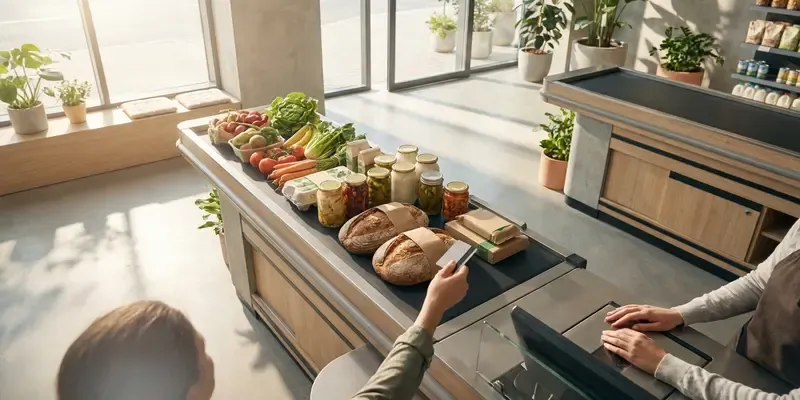
Stop Following the Crowd: The Secret to Faster Checkout
You’re standing at the edge of the checkout zone, eyes darting like a tactical commander. To your left, three people with a few items each. To your right, one person with a mountain of groceries. Your instinct screams to go left. Your instinct is wrong.
The Myth of the Express Lane
We’ve been conditioned to believe that fewer items equal less time. It’s a logical fallacy that wastes hours of our lives. When you apply Queue Science, you realize that the volume of goods is rarely the bottleneck. Scanning a box of pasta takes roughly 1.5 seconds. It’s a mechanical, rhythmic motion. The real enemy of your Saturday afternoon isn’t the pile of groceries; it’s the “start-up cost” of every new human being in the line.
Understanding Transaction Friction
Every person in front of you represents a set of unpredictable variables. This is what experts call transaction friction. Think about the ritual:
- The initial “How are you today?” exchange.
- The frantic search for the loyalty card.
- The “wait, I have a coupon somewhere” moment.
- The inevitable card reader error or PIN entry delay.
Research into Queue Science suggests these “fixed costs” add about 41 seconds to every transaction. If you choose the line with three people, you’ve just added over two minutes of pure administrative lag before a single item is even scanned.
The Single Avocado Disaster
I learned this the hard way at a local grocery store. I saw a woman with a single avocado and jumped behind her, feeling smug. My other option was a man with a cart that looked like he was prepping for a long winter. The Avocado Lady couldn’t find her chip-enabled card. Then she wanted to check the price because she thought it was on sale for 99 cents, not $1.29. By the time she cleared the lane, the man with the full cart was already loading his bags into his car. I had traded ten minutes of my life for the illusion of a “short” line. I could still smell the floor wax and the faint scent of overripe bananas as I stood there, fuming.
How to Choose Your Lane
Next time you’re ready to pay, ignore the cart volume and count the heads.
- Prioritize the “Big Haul”: One person with 60 items is almost always faster than four people with 15 items each.
- Watch the “Leads”: Look for “professional” shoppers—people who already have their wallets out and their groceries organized on the belt.
- Avoid the Chatters: If the cashier and the customer are mid-conversation about the local weather, move on immediately.
Conclusion: Reclaim Your Time
Speed isn’t about what’s in the cart; it’s about the person behind it. By leaning into Queue Science, you stop gambling on human behavior and start betting on the efficiency of the machine. Next time, pick the full cart. You’ll be home while the “express” shoppers are still digging for their spare change.
FAQs
Q: Is self-checkout always the fastest option? A: Not necessarily. Self-checkout has the highest friction because the user is an amateur. One “unexpected item in bagging area” error wipes out any time saved.
Q: Does the cashier’s speed matter more than the line length? A: Absolutely. A fast, focused cashier can process a full cart faster than a distracted one can scan a loaf of bread.
Q: What if the person with the full cart has tons of produce? A: Produce is a wild card. Weighing and look-up codes add friction. If the cart is 50% loose apples, you should reconsider your choice.
Q: Should I ever choose the express lane? A: Only if it is completely empty. If there are more than two people waiting, the math usually favors the regular lanes with fewer people.
Q: Why do we feel like the other line is always faster? A: This is “occupational bias.” We notice when we are stalled, but we don’t notice when we are moving smoothly. It’s a psychological trick.
Q: Is there a best time of day to shop? A: Tuesday and Wednesday evenings are statistically the lowest volume times. If you want to avoid the stress of choosing, shop when everyone else is at home.


