
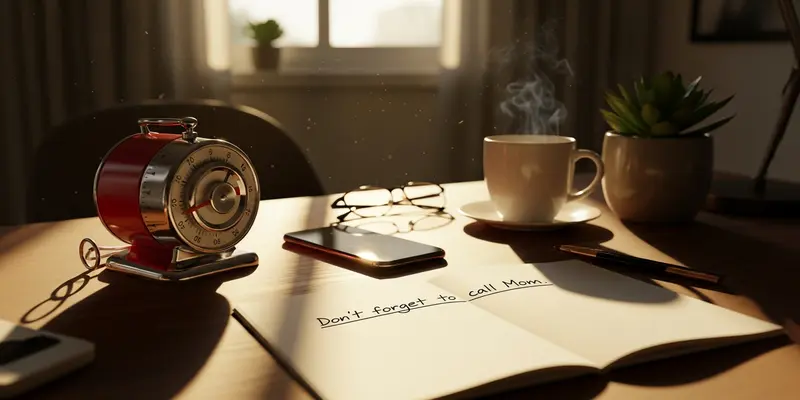
You are staring at a ten-digit number on your screen. Your thumb hovers over the green icon, but your chest feels tight. This isn’t just a phone call; it’s a mountain you’re not prepared to climb. This is the paralyzing reality of phone call anxiety, a quiet thief of productivity that turns simple administrative tasks into weeks of dread.
Most people tell you to "just do it." They are wrong. You can’t "just do" something your brain perceives as a threat. You need a strategy to bypass the amygdala and get the job done. That’s where the two-minute timer comes in.
The Psychology of the 120-Second Contract
Procrastination isn’t about laziness. It is about emotion regulation. When you look at a difficult call—whether it’s to the bank, a doctor, or a landlord—your brain focuses on the potential for conflict or awkwardness.
The two-minute timer works because it creates a finite window for discomfort. You aren’t committing to a long, grueling battle. You are committing to two minutes of action. It lowers the stakes. You tell your brain: "We are going to feel uncomfortable for exactly 120 seconds, and then we can stop." Usually, the call is over before the timer dings.
Scripting: Your Shield Against the ‘Um’
The second half of this hack is the script. Not a manifesto—just the first sentence.
- The Script: "Hi, my name is [Name], and I’m calling because [Reason]."
- Why it works: The hardest part of any call is the first five seconds. By scripting the opening, you remove the cognitive load of having to think while your heart is racing. You become an actor playing a role. Once the agent on the other end responds, the social script takes over naturally.
The Day I Stopped Running
I remember sitting at my cluttered wooden desk three years ago, the smell of cold coffee lingering in the air. I had an insurance bill that was clearly wrong—a $450 error that had been sitting there for a month. Every time I looked at the envelope, my stomach did a somersault.
I was convinced the person on the other end would be mean, or that I wouldn’t have the right paperwork, or that I’d look stupid. I finally grabbed a kitchen timer, set it for two minutes, and wrote down: "Hi, I’m calling about a billing discrepancy on account 5592."
I hit dial. My palms were slick with sweat. The representative answered on the third ring. I read my sentence. The fear vanished instantly because I was finally moving. The call took exactly four minutes, and the $450 charge was gone. I spent thirty days worrying about four minutes of reality.
How to Execute the Hack Today
- Identify the Call: Pick the one you’ve been avoiding the longest.
- Write the Opener: One sentence only. Put it on a Post-it note.
- Set the Timer: Use your phone or a physical timer. Set it for 2:00.
- Hit Dial: Do not check your email. Do not get a glass of water. Just press the button.
Action is the only cure for dread. The phone isn’t a weapon; it’s a tool. Use the timer to remind yourself that you can handle anything for two minutes.
FAQs
Q: What if I get put on hold? Put the phone on speaker and go back to what you were doing. The timer is for the active part of the call. Being on hold is just background noise.
Q: What if they ask a question I can’t answer? It is perfectly okay to say, "That’s a great question, let me find that for you" or "I’m not sure, let me check my records." You don’t need to be an expert.
Q: Why does the timer help if the call takes longer? The timer is a psychological starter motor. Once you are in the conversation, the ‘dread’ phase is over, and your brain naturally switches to problem-solving mode.
Q: Is it okay to use a script for the whole call? It’s better to only script the start. If you script the whole thing, you’ll panic if they deviate from your plan. Trust your ability to converse once the ice is broken.
Q: Does this work for business calls too? Absolutely. Professional calls are often easier because they follow a predictable structure. The 2-minute rule is universal for any task involving high mental friction.
Q: What if I start shaking or my voice cracks? Let it crack. The person on the other end is just a human doing their job. They’ve spoken to hundreds of people today; they won’t remember a shaky voice, but you will remember that you finished the task.