
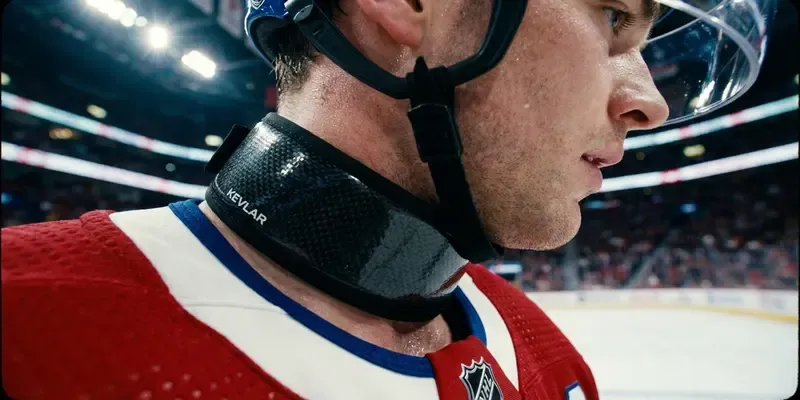
Why Olympic Neck Guard Rules Are a Wake-Up Call for the NHL
The glare of the Olympic rings doesn’t just bring prestige; it brings a tightening of the collar—literally. For NHL stars used to the breezy freedom of an open-necked jersey, the transition to Olympic play involves a mandatory adjustment that many find suffocating. We are talking about the neck guard, a piece of equipment that has become the most debated ‘cold knowledge’ fact of the games.
While the NHL largely leaves this choice to the players, the International Ice Hockey Federation (IIHF) doesn’t play games with jugulars. At the Olympics, if you aren’t wrapped in cut-resistant Kevlar, you don’t step on the ice. It’s a clash of culture versus common sense, and it’s time we stopped prioritizing ‘player comfort’ over preventable tragedies.
The Invincibility Complex
Professional hockey players are creatures of habit. They trim their sticks to the millimeter and bake their skates for the perfect fit. To them, a neck guard feels like a leash. It’s scratchy, it’s hot, and it supposedly ruins their ‘field of vision.’
But let’s be real: this resistance is rooted in a false sense of invincibility. In the NHL, the ‘tough guy’ aesthetic still lingers. There’s an unspoken rule that extra padding is for the timid. The Olympics, however, act as the adult in the room, stripping away the ego and replacing it with a hard-and-fast mandate that saves lives.
Why the NHL Is Lagging Behind
- Tradition over Safety: The league often waits for a catastrophe before making changes (think helmets or visors).
- Player Choice: The NHL Players’ Association (NHLPA) fiercely protects the right of players to choose their own gear, even when that gear is objectively less safe.
- The Aesthetic Factor: Let’s be honest—some players think neck guards look ‘junior.’
This gap between Olympic standards and NHL reality is more than just a quirk; it’s a liability. When the world’s best players can adapt to neck guards for a three-week tournament, the argument that they ‘can’t play’ with them falls flat.
A Moment of Cold Reality
I remember being rink-side during a high-speed collision a few years back. The sound of a sharpened blade hitting the ice is usually rhythmic, almost musical. But when a skate kicks up high in a scramble, that sound turns into a sickening ‘zip.’
I watched a teammate reflexively clutch his throat after a goal-mouth scramble. He wasn’t cut, but the look of pure, unadulterated terror in his eyes—the realization that his life was millimeters away from a jagged piece of steel—is something I’ll never forget. He bought a neck guard the next morning. We shouldn’t wait for the ‘zip’ to happen to us before we acknowledge that our throats are the most vulnerable part of the human machine on ice.
Adapting to the New Normal
Modern technology has killed the ‘itchy’ excuse. We aren’t in 1995 anymore. Today’s neck guards are integrated into base layers, using breathable, moisture-wicking fabrics that are stronger than steel.
Olympic athletes are proving that you can still score hat tricks and play lockdown defense while protected. The ‘Mandatory’ accessory isn’t a burden; it’s a baseline. If the Olympics can mandate it for the greatest stage on earth, the NHL has no excuse left to hide behind.
Conclusion
Safety shouldn’t be a suggestion. The Olympic mandate on neck guards isn’t an overreach; it’s a necessary evolution of a violent, high-speed sport. It’s time for the professional hockey world to follow suit and realize that a little bit of fabric is a small price to pay for coming home after the game.
What do you think? Is it time for the NHL to make neck guards mandatory, or should players keep the right to choose? Let’s hear your take.
FAQs
Q: Are neck guards mandatory in the NHL? A: No. While the NHL strongly recommends them, they are currently optional for players, unlike in the Olympics or many European leagues.
Q: What are Olympic neck guards made of? A: Most are made of cut-resistant materials like Kevlar or Spectra fibers, designed to prevent skate blades from penetrating the skin.
Q: Why do NHL players dislike wearing them? A: Common complaints include restricted heat dissipation, irritation against the skin, and a perceived reduction in neck mobility.
Q: Has there ever been a fatal neck injury in the NHL? A: While there have been several near-fatal incidents (like Clint Malarchuk or Richard Zedník), the league has managed to avoid a fatality through elite medical response, not preventative gear.
Q: Do neck guards protect against impacts? A: Primary neck guards are designed for cut resistance. However, some padded versions do offer a small degree of protection against puck or stick impacts.
Q: Will the NHL eventually mandate them? A: Discussions between the NHL and the NHLPA have intensified recently, especially following high-profile accidents in other professional leagues, suggesting a mandate may be coming soon.


