
Stop Sucking at Guitar: The Secret to a God-Tier Off-Hand
Imagine you are mid-solo, the crowd is leaning in, and suddenly your fretting hand turns into a bag of wet cement. It’s not a lack of talent. It’s not even a lack of practice. It is a fundamental neurological bottleneck. Most musicians treat their Non-Dominant Hand Dexterity like a seasonal hobby rather than a survival skill, and that is exactly why your progress has plateaued.
We live in a world designed for our dominant side. From doorknobs to scissors, everything reinforces your brain’s favoritism. If you only engage your weaker hand during the two hours you spend with your instrument, you are fighting a losing battle against 22 hours of atrophy.
Why Your Practice Drills are Failing You
Traditional drills are great for muscle memory, but they are isolated. They happen in a vacuum. When you sit down with a guitar or at a piano, your brain enters “performance mode.” It’s stressed. It wants to rely on what it already knows. To truly unlock that hand, you need to bypass the stress of the instrument.
- Neural Path Development: You need to build the highway before you can drive the Ferrari.
- Passive Training: Training shouldn’t just happen at a bench; it should happen at the sink.
- Proprioception: You need to know where your fingers are without looking at them.
The Off-Hand Lifestyle Shift
You don’t need more metronome time. You need to stop being a one-handed human. Start with the small stuff. Pick up your phone with your weak hand. Reach for the remote. These seem trivial, but they force the motor cortex to fire in ways it hasn’t since you were a toddler.
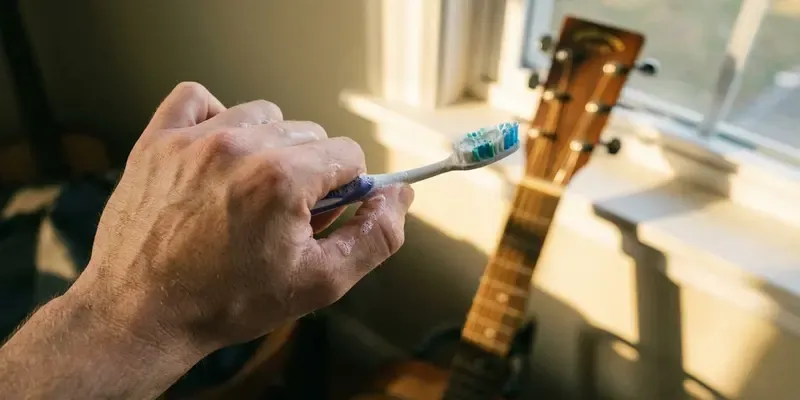
- Brushing Teeth: This is the ultimate fine motor challenge. It requires a mix of steady pressure and micro-movements.
- Carrying Bags: Build that forearm endurance. If you can carry three bags of groceries with your pinky and ring finger, a barre chord is nothing.
- Opening Doors: Turning a key or a handle builds wrist rotation and grip precision.
The Morning My Left Hand Finally Woke Up
I remember the exact moment I realized I was a fraud. I was trying to master Chopin’s “Revolutionary Étude,” and my left hand felt like a useless lobster claw. It couldn’t keep up with the cascading runs. I was frustrated, bordering on quitting.
Then, I decided to conduct an experiment: I would do everything with my left hand for a month. The first morning was a disaster. I tried to eat a bowl of cereal and ended up wearing more milk than I drank. It was humiliating. But three weeks in, I noticed something weird. When I picked up my instrument, the “clumsiness” was gone. My fingers felt independent, crisp, and alive. I wasn’t thinking about the movements anymore; they just happened. I realized that by struggling with a spoon, I had built the neural infrastructure to handle a keyboard.
Take the Stand: Stop Coddling Your Weakness
If you want to be an elite musician, you have to stop being lazy in your daily life. It’s uncomfortable to be clumsy, and that’s exactly why you should do it. Comfort is where skill goes to die.
Start tomorrow morning. Put your toothbrush in the “wrong” hand. It will feel awkward. You might even poke yourself in the cheek. Good. That discomfort is the feeling of new neurons connecting. Embrace the clumsiness now so you can enjoy the mastery later.
FAQs
Q: How long does it take to see results in my playing? Most musicians notice a significant difference in finger independence within 14 to 21 days of consistent daily-task switching.
Q: Will this actually help with speed? Yes. Speed is often limited by the brain’s inability to send clear signals to individual fingers. Improving general dexterity clears the signal noise.
Q: Can I overtrain my non-dominant hand? It’s possible but unlikely. Unlike heavy lifting, chores involve low-impact movements. Just listen to your body and avoid anything that causes sharp pain.
Q: Should I stop using my dominant hand entirely? No, that’s impractical. The goal is to bring your weak hand up to a baseline of 70-80% of your dominant hand’s capability.
Q: Does this work for all instruments? Absolutely. Whether it’s fretting a guitar, navigating a flute’s keys, or handling a drumstick, better motor control is universal.
Q: Is there a specific chore that is best? Brushing your teeth and using a computer mouse are the gold standards for fine motor development and hand-eye coordination.


