
Stop the Spiral: The 'Novel' Sleep Hack for Nighttime Anxiety
You’re staring at the ceiling, and your brain is currently a 24-hour news cycle of every mistake you’ve ever made. The more you try to force yourself to sleep, the louder the internal screaming gets. This is the irony of the modern mind: we are experts at over-analyzing but amateurs at shutting down. If you’ve tried white noise, warm milk, and counting sheep to no avail, it’s time to stop fighting your thoughts and start editing them. The [Novel Sleep Hack] isn’t just a TikTok trend; it’s a masterclass in psychological distancing that actually works.
The Psychological Kill-Switch: Shifting Perspective
Most people fail at sleeping because they remain the protagonist of their own misery. When you think in the first person—“I am stressed,” “I need to wake up in five hours,” “I forgot to email Dave”—your amygdala stays on high alert. You are the one in the line of fire.
By switching to the third person, you create immediate emotional distance. You aren’t the one panicking anymore; you are simply an observer watching a character named ‘He’ or ‘She’ or ‘They’ prepare for rest. It sounds absurdly simple, but it forces the brain to move from abstract, chaotic anxiety into concrete, linear storytelling. You can’t narrate a scene and spiral into a panic attack at the same time. The brain’s bandwidth won’t allow it.
How to Narrate Your Way to the Dream World
To make this work, you have to embrace the mundane. You aren’t writing an action thriller; you’re writing a slow-burn literary fiction piece where absolutely nothing happens. Focus on sensory details that ground the character in the physical world.
- Start with the body: “He felt the weight of the heavy cotton blanket against his toes.”
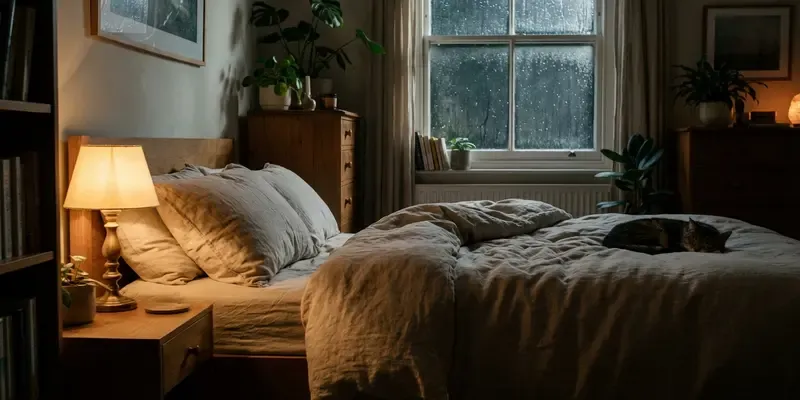
- Describe the environment: “The room was dark, save for a sliver of streetlamp light hitting the wardrobe.”
- Narrate the breath: “She took a slow breath, noticing the cool air in her nostrils and the warmth as she exhaled.”
By the time you get to describing how the character’s shoulders are dropping an inch deeper into the mattress, your heart rate has usually followed suit.
The Night I Stopped Fighting My Brain
I remember a Tuesday last November. My heart was hammering against my ribs because a project deadline was looming, and I was convinced my career was over. I’d been lying there for three hours. In desperation, I tried this. I started whispering in my head: “He pulled the duvet up to his chin. The fabric felt slightly rough against his skin. He listened to the distant hum of a car passing on the wet pavement outside.”
It felt silly for about thirty seconds. Then, something strange happened. The ‘me’ that was terrified of the deadline started to feel like a character in a book I was bored with. I wasn’t the stress; I was the person describing the stress. I didn’t even make it to the part where the character closed his eyes. I woke up eight hours later with the lights still on.
Why Linear Processing Wins
Anxiety is circular. It loops. Narration, however, is linear. You have to move from one sentence to the next. You have to find the right adjective. This requires a level of cognitive load that is just high enough to crowd out intrusive thoughts, but low enough to let the parasympathetic nervous system take the wheel. You are essentially boring your anxiety to death.
If you want to reclaim your nights, stop being the victim of your thoughts. Start being the author. Describe the character, describe the room, and let the story end in silence.
FAQs
Q: Do I have to speak out loud? No. In fact, keeping the narration as an internal monologue is usually more effective for drifting off.
Q: What if I run out of things to describe? Go deeper into the senses. Describe the texture of the pillowcase, the temperature of the air, or the specific sound of your own breathing.
Q: Does it matter what name I use? Use your own name or a simple pronoun (he/she/they). The goal is to create distance between “You” and the “Character.”
Q: Can I use this for daytime anxiety? Absolutely. Narrating your walk to the kitchen or your drive to work can help ground you during a localized panic spike.
Q: How long does it usually take to work? Most practitioners find they are asleep within 5 to 10 minutes of consistent narration.
Q: What if my thoughts keep jumping back to my ‘to-do’ list? Acknowledge it in the story. “The character thought about his list for a moment, then decided to return his focus to the softness of the pillow.” Then keep going.


