
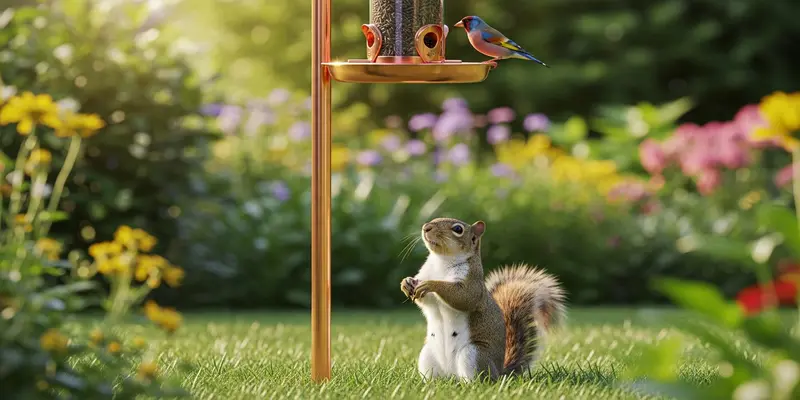
Watching a squirrel treat your “squirrel-proof” feeder like an all-you-can-eat buffet is a unique kind of aggravation. You spent forty bucks on premium sunflower seeds, and within twenty minutes, a furry gymnast has bypassed every obstacle you’ve built. The industry wants you to buy $100 motorized spinning feeders or ultrasonic blasters that do exactly nothing. Forget that. The real solution is a Non-Stick Hack: An Inexpensive, Food-Safe Way to Keep Squirrels Off Your Bird Feeder Pole that relies on basic physics and a common kitchen staple.
Why Most Deterrents Fail
Squirrels are nature’s most dedicated engineers. They have nothing but time and a high-calorie incentive to figure out your gear. Most commercial baffles are too small, and “squirrel-proof” cages often just provide the squirrels with a better grip. To beat them, you have to stop thinking about barriers and start thinking about friction—or the total lack of it. If they can’t grip, they can’t climb.
The Non-Stick Solution: Food-Grade Mineral Oil
The secret isn’t some toxic chemical or a complex trap. It is food-grade mineral oil. Unlike vegetable oils, which turn rancid and sticky (attracting dirt and eventually becoming a ladder for squirrels), food-grade mineral oil remains slick and clear. It’s the same stuff used to treat wooden cutting boards, so it’s completely safe for the environment and the birds.
- The Prep: Wipe your metal pole down with white vinegar to remove grease, grit, and spiderwebs.
- The Application: Apply a thin, even coat of mineral oil using a lint-free cloth or a paper towel.
- The Physics: The squirrel’s claws can’t find purchase on the microscopic level. They slide down before they reach the top.
Why Safety is the Priority
I’ve seen people suggest using axle grease or WD-40. Don’t do it. Those substances are toxic and oily disasters. If a bird accidentally brushes against a pole covered in heavy grease and gets those chemicals on its feathers, it can’t preen properly, leading to hypothermia or death. Our goal is to outsmart the squirrels, not poison the ecosystem. Food-safe mineral oil provides the “slip” without the “sick.”
The Day I Outsmarted Goliath
I used to have a resident squirrel I named Goliath. This guy was the size of a small housecat and possessed the athletic prowess of an Olympic gymnast. I’d tried the spicy seeds (he liked the flavor) and the plastic baffles (he used them as a springboard).
One humid Saturday, I decided to try the mineral oil hack. I cleaned the copper pole until it shone and buffed on a thin layer of oil. I sat back on my porch with a glass of iced tea and waited. Five minutes later, Goliath made his move. He took a running start, leaped at the pole, and… drifted. He didn’t fall; he just slid down the pole in slow motion, his tiny claws scratching fruitlessly against the slick surface. He landed on his butt, looked up at the feeder with a look of pure, bewildered betrayal, and trotted off. I haven’t lost a scoop of seed since.
Maintenance: Keeping it Slick
This isn’t a “set it and forget it” solution. Rain and dust will eventually break down the barrier or provide enough grit for a squirrel to get a toehold. To keep the birds happy and the squirrels grounded, re-apply the oil every few weeks or after a particularly heavy storm. It takes thirty seconds and costs pennies per application.
Conclusion: Take Back Your Garden
You don’t need a high-tech security system for your backyard. You just need to make the climb impossible. By using a food-safe lubricant on a clean pole, you’re choosing a solution that is humane, cheap, and incredibly satisfying to watch. Go ahead, reclaim your feeder and finally enjoy the birds in peace.
FAQs
Is vegetable oil okay to use instead?
No. Vegetable oil turns rancid quickly and becomes a sticky, gummy mess that actually helps squirrels grip the pole. Stick to mineral oil.
Will this hurt the birds?
As long as you use food-grade mineral oil and apply it thinly to the pole (not the feeder itself), it is safe. Birds rarely land on the pole; they land on the feeder arms or the perches.
How often should I re-apply the oil?
Usually once every two to three weeks, or immediately after a heavy rainstorm that might wash it away.
Can I use this on wooden poles?
It is less effective on wood because the oil soaks into the fibers. This hack works best on smooth metal or PVC poles.
What if the squirrel jumps from a tree?
If your feeder is within 10 feet of a tree or structure, no hack will work. You must move the pole to an open area first to force them to climb.
Are there other non-stick options?
Some enthusiasts use a metal Slinky slipped over the pole. When the squirrel grabs it, the Slinky stretches and drops them back to the ground. It’s a great mechanical alternative to oils.