
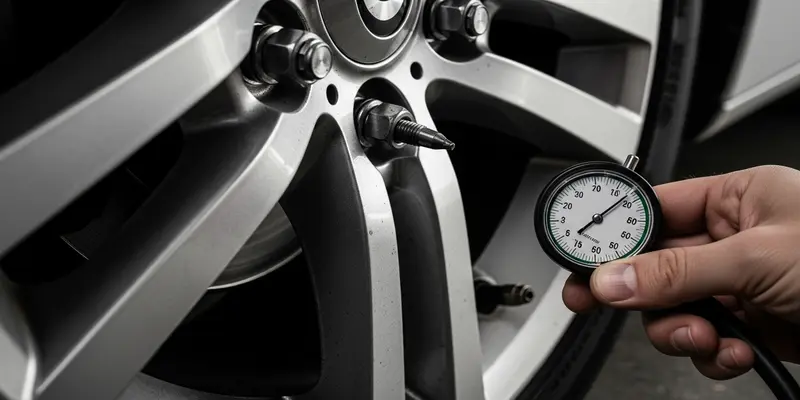
Imagine this: You’re at a gas station, the air compressor is humming its rhythmic tune, and you’re just trying to get your PSI back to 32 before the commute. You glance down at the rim and see it—a hollow, threaded void. A missing lug nut. It’s a quiet realization that turns your stomach. If you hadn’t looked, that wheel might have decided to take a different path than the rest of the car at 70 mph. Discovering a missing lug nut during a routine tire inflation isn’t just a nuisance; it’s a structural emergency masquerading as a minor inconvenience.
The Lethal Illusion of Stability
Most drivers treat their wheels like furniture—static, permanent, and indestructible. They aren’t. Your wheels are held on by five or six small pieces of hardware fighting immense centrifugal force and constant road vibration. When one goes missing, the geometry of safety changes instantly.
Driving with a missing nut puts uneven, oscillating stress on the remaining studs. It’s a classic domino effect. One nut disappears, the others begin to vibrate loose under the increased load, and then the studs snap. It’s rarely a slow failure; it’s usually a violent, sudden separation of man and machine.
The Mechanics’ Sin: Why They Fall Off
We tend to trust tire shops blindly, but the truth is that high-volume shops are breeding grounds for error. Impact wrenches are the enemy of precision. I’ve seen plenty of “pros” blast lug nuts on so tight they stretch the threads to the breaking point, or conversely, leave them just “hand tight” because a coworker distracted them.
- Over-torquing: This stretches the metal of the stud until it becomes brittle. One good pothole and the stud snaps off like a dry twig.
- Under-torquing: Allows the natural harmonics of the road to back the nut off the stud.
- Cross-threading: Ruining the seat of the nut means it isn’t actually holding anything, even if it looks “on.”
The Day the Highway Started Shaking
I learned the importance of the visual check the hard way on a rainy Tuesday outside of Philadelphia. I’d just had my winter tires swapped by a reputable chain. Two days later, I felt a rhythmic “thrum” in the steering wheel. I ignored it for five miles, blaming the uneven asphalt. By mile ten, the car began to shudder with a violence that suggested the engine was trying to leap out of the hood.
I pulled over on a narrow shoulder, soaked to the bone, and found three of the five nuts on my front-left wheel were loose enough to spin by hand. One was gone entirely, lost somewhere back on I-95. The “expert” at the shop had clearly skipped the torque wrench. Since that day, I don’t put the car in gear until I’ve personally verified every single nut is seated.
Make It a Ritual
You’re already down there checking the pressure. You’ve already got your hands dirty. Use those ten seconds. Every time that air hose comes out, your eyes should do a lap around the rim.
- The Count: It sounds silly, but count them. 1, 2, 3, 4, 5.
- The “Rust Tear” Test: Look for orange or brown streaks radiating from the nut. This is a tell-tale sign that the nut is loose and vibrating, grinding metal into dust.
- The Depth Check: Does one nut look more “shallow” than the others? It might be backed off.
Your Life is Worth Ten Seconds
Safety isn’t found in expensive sensors or complex lane-assist technology. Real safety is found in the small, boring observations made by an attentive owner. Don’t wait for a vibration or a clunking sound to tell you your wheel is loose. By then, the metal is already failing.
Next time you fill your tires, look at your wheels. Really look at them. If a hole is empty, or a nut looks skewed, do not ignore it. Buy a torque wrench, learn your vehicle’s specs, and take control of your own safety. Your life, and the lives of those sharing the road with you, are worth the extra ten seconds of effort.
FAQs
Q: Is it safe to drive to the shop with one missing lug nut? A: It is extremely risky. While the wheel might stay on for a few miles, the remaining studs are under massive stress. If you must, drive slowly and avoid highways.
Q: How do I know the correct torque for my lug nuts? A: Check your owner’s manual under the “Specifications” or “Tire Change” section. Most passenger cars require between 80 and 100 lb-ft.
Q: Should I use anti-seize lubricant on my lug studs? A: Most manufacturers actually recommend against this. Lubricant can lead to over-torquing because it reduces friction, causing you to stretch the stud before the wrench clicks.
Q: Why does my steering wheel shake if a lug nut is loose? A: A loose nut allows the wheel to “yaw” or wobble on the hub. This imbalance creates a vibration that travels through the suspension and up the steering column.
Q: Can a missing lug nut damage my rim? A: Absolutely. If the wheel is loose, the steel studs will grind against the softer aluminum of the rim, ovalizing the holes and potentially ruining the wheel entirely.
Q: Do I need to check them after a tire rotation? A: Yes. Standard practice is to re-check the torque after the first 50 to 100 miles of driving, as the heat and vibration can cause the metal to settle.