
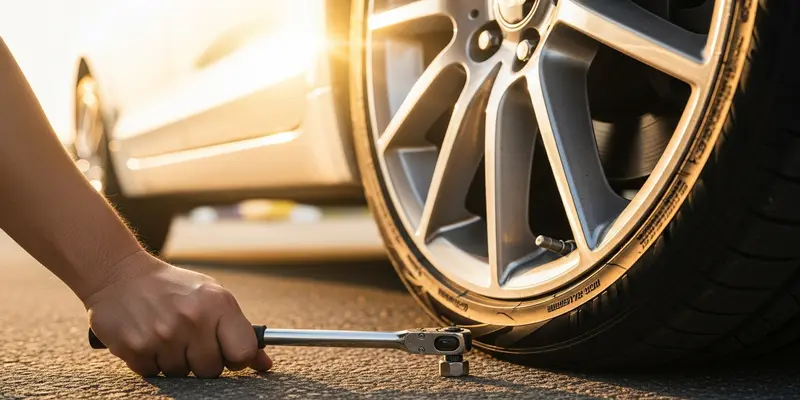
The Silent Threat in Your Wheel Well
Most people treat their cars like appliances. They turn the key, and it goes. But your wheels are held on by nothing more than friction and physics. Finding a missing lug nut during a routine pressure check is a heart-stopping moment that should change how you drive forever. It’s not just a mechanical failure; it’s a failure of habit.
Why the 100-Mile Rule is Non-Negotiable
When a shop installs a wheel, they use a torque wrench—or at least, they should. But metal is a dynamic material. As you drive, the heat generated by your brakes and the constant vibration of the road cause the wheel to “seat” against the hub.
- Bolts stretch slightly under load.
- Aluminum wheels can compress at the contact points.
- Microscopic debris or rust can flatten out.
The industry standard is to re-torque your wheels after the first 50 to 100 miles of driving. If you ignore this, you are essentially leaving your life to the hope that nothing shifted. Hope is not a safety strategy.
Make the Gas Pump Your Inspection Station
Don’t just stand there staring at the gas pump’s price screen while your wallet drains. That three-minute window is the perfect time for a visual sweep. You don’t need tools for this—just your eyes.
Walk around the car. Look for:
- Empty studs where a nut should be.
- Rust streaks bleeding from a nut (a classic sign of vibration and looseness).
- Lug nuts that look “backed off” compared to their neighbors.
The Day I Almost Lost a Wheel
I learned this lesson the hard way on a rain-slicked highway in the Pacific Northwest. I was cruising at 60 mph when a subtle vibration started in the floorboards. It wasn’t a violent shake; it was a rhythmic tick-tick-tick that I felt more than I heard.
I pulled over under a dim streetlamp, drenched in freezing rain, and touched the rear passenger wheel. It was radiating heat. Two lug nuts were completely gone, lost to the asphalt miles back. The remaining three were so loose I could turn them with my bare thumb. The shop had rushed the job, and I had failed to double-check. If I hadn’t stopped, that wheel would have overtaken me on the shoulder within minutes.
Take Ownership of Your Safety
Stop delegating your survival to a busy technician who might be on the tenth hour of a grueling shift. Mechanics are human; they make mistakes. Metals are physical; they move.
Buy a decent torque wrench and keep it in your trunk. It costs less than a single tire, and it certainly costs less than an insurance deductible. Every time you check your tire pressure, check your nuts. It’s a five-second habit that keeps your wheels where they belong: on the car.
FAQs
Can I drive with one missing lug nut? Technically, the car will move, but you shouldn’t. One missing nut puts uneven, oscillating stress on the remaining studs, which can cause them to snap off in rapid succession.
How do I know if my lug nuts are loose while driving? Listen for a clicking or thumping sound that changes with vehicle speed. You may also feel a wobble in the steering wheel or a vibration through the seat.
What is the correct torque for my car? Every vehicle has a specific torque spec, usually between 80 and 100 lb-ft for cars. You can find this in your owner’s manual or on a sticker inside the driver’s door jamb.
Should I use WD-40 or grease on my lug studs? No. Never lubricate the threads unless specifically instructed by the manufacturer. Dry torque is the standard; lubrication can lead to over-tightening and snapping the stud.
Why do wheels come loose after a professional rotation? Usually, it’s due to “settling.” Small amounts of dirt, paint, or rust between the wheel and the hub can compress over time, creating a tiny gap that allows the nut to lose its clamp load.
What are the signs of a failing wheel stud? Look for stretched threads or a stud that appears thinner than the others. If the threads are flattened or cross-threaded, the stud must be replaced immediately to ensure the nut can hold properly.