
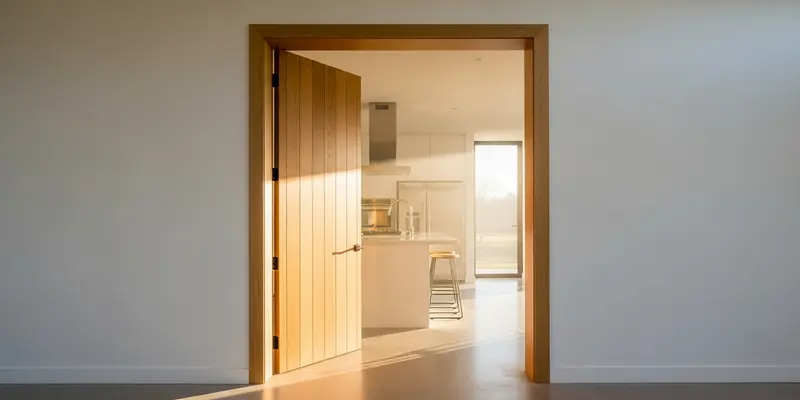
You are standing in the middle of your kitchen, staring blankly at a toaster. Two minutes ago, you were in your home office with a brilliant idea. Now? Nothing. The Doorway Effect has struck again, and it’s not because you’re getting old or losing your mind. It’s because your brain is a ruthless efficiency machine that views every door as a ‘Save and Exit’ button.
Most people treat this cognitive hiccup as a failure. They get frustrated, rub their temples, and try to force the thought back into existence. That is a waste of energy. To beat the doorway effect, you have to stop fighting your biology and start working with it.
The Brain’s Filing Cabinet Problem
Your brain doesn’t store memories in a continuous, cinematic stream. Instead, it segments your life into ’event models.’ When you move from the living room to the kitchen, your brain essentially archives the ’living room’ file and opens a blank ‘kitchen’ file. It assumes the information you needed at your desk isn’t relevant to your current location near the stove.
This is known as context-dependent memory. Your environment acts as a physical scaffolding for your thoughts. When you remove the scaffolding by walking through a door, the thought collapses. It’s a design feature, not a bug. It prevents your mind from being cluttered with irrelevant data from three rooms ago.
How to Reclaim Your Lost Thoughts
If you want to stop the mental drain, you need to bridge the gap between rooms. Don’t just walk; carry the context with you.
- The Visualization Anchor: Before you step through the frame, visualize the object or task. Don’t just think ‘scissors.’ Visualize the cold metal in your hand and the sound of them cutting paper.
- The Verbal Loop: Say it out loud. ‘I am going to get the stapler.’ Speaking engages a different part of the brain, creating a secondary memory trace that is harder to wipe.
- Physical Retracing: If you forget, don’t just stand there. Physically move back to the exact spot where the thought originated. Your brain needs the environmental cues to ’re-open’ the archived file.
The Cold Metal and the Missing Screwdriver
I remember one humid July afternoon when I was fixing a loose hinge on my back deck. I realized I needed a specific flat-head screwdriver from the garage. I walked through the mudroom, through the kitchen, and into the garage. The moment the heavy steel door clicked shut behind me, the mission evaporated.
I stood there, smelling the faint scent of old gasoline and lawn clippings, staring at a stack of cardboard boxes. I felt that specific, itchy irritation of a lost thought. Instead of standing there like a statue, I turned around. I walked back through the kitchen, back to the deck, and gripped the loose hinge. The moment my fingers touched the warm wood, the image of the yellow-handled screwdriver snapped back into my mind. I didn’t just remember it; I felt the urgency of the repair return. Context isn’t just where you are; it’s what you’re doing.
Stop Fighting Your Biology
We live in a world that demands constant multi-tasking, but our brains are still wired for local, contextual survival. The next time you find yourself staring at a fridge with no idea why, don’t panic. You haven’t lost your edge. You’ve just experienced a transition. Turn around, walk back, and let the room remind you who you are.
FAQs
Q: Is the Doorway Effect a sign of early-onset dementia? No. It is a documented cognitive phenomenon that happens to people of all ages. It is a result of how the brain segments tasks, not a degradation of the brain itself.
Q: Why does it happen even when I’m not in a hurry? Speed isn’t the primary factor; the physical transition is. Even a slow walk through a door signals to the brain that one ’episode’ has ended and another has begun.
Q: Does this happen in digital environments? Yes. Switching between tabs or apps can trigger a digital version of the doorway effect. The ’new’ screen acts as a new room, causing you to forget why you opened the browser.
Q: Can I train my brain to stop doing this? You can’t really ’train’ it away, but you can use strategies like verbalizing your goal or ‘mental walking’ to minimize the impact.
Q: Why does retracing my steps work so effectively? Retracing your steps provides the brain with the original sensory cues (sights, smells, sounds) that were present when the thought was formed, acting as a key to the archived memory.
Q: Is the Doorway Effect related to ADHD? While everyone experiences it, people with ADHD may find it more frequent or disruptive because their brains already struggle with working memory and task-switching.