
The sharp, sudden sting of a split fingernail is a universal agony. We’ve all been there: hunched over a stubborn metal loop, trying to pry it open just enough to slide on a new house key or a car fob. It’s a battle of biology versus tempered steel, and usually, your manicure loses.
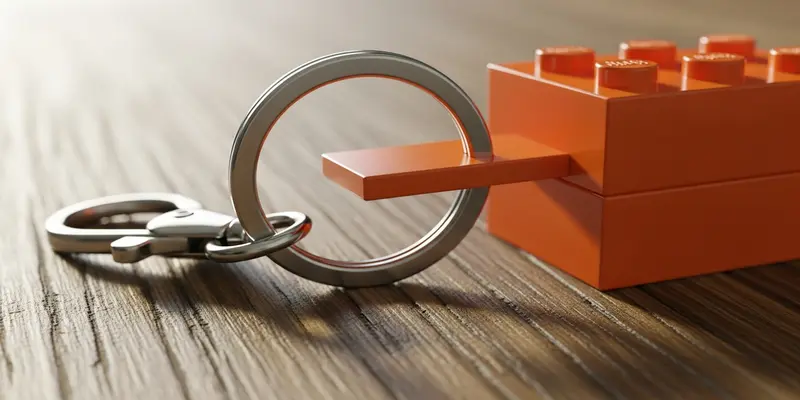
But there is a better way. If you want to know how to open a key ring easily without hurting your fingernails, the answer isn’t a specialized tool from a hardware store. It’s likely sitting in your kid’s toy box. It’s the humble LEGO brick separator.
The Design Flaw of the Modern Key Ring
Split rings are designed for security, not accessibility. They are intentionally stiff to ensure your keys don’t go flying while you’re jogging or fumbling at your front door.
However, this tension makes them a nightmare for anyone with short nails, long nails, or sensitive fingertips. Using your nails as a wedge is a recipe for disaster. You aren’t just risking a chip; you’re risking a painful tear that takes weeks to heal.
Why the LEGO Separator is the Ultimate Hero
If you’ve ever bought a mid-sized LEGO set, you probably have an orange or teal plastic wedge lying around. Most people toss them in a junk drawer and forget they exist.
That little plastic tool is a masterpiece of leverage. It features a thin, tapered edge designed to slide between tight plastic bricks without scratching them. That same edge is perfectly calibrated to slide into the coil of a key ring.
- Perfect Thickness: It’s thick enough to create a gap, but thin enough to enter.
- Material: The plastic is durable but softer than steel, so it won’t scratch your keys.
- Ergonomics: It provides a handle, giving you more control than a coin or a flathead screwdriver.
How to Execute the Hack Like a Pro
- Identify the Opening: Look for the end of the wire on the top layer of the ring.
- Insert the Wedge: Slide the thin, flat end of the LEGO separator directly into the split.
- Twist or Push: Give the separator a slight nudge. The ring will pop open effortlessly.
- Slide the Key: With the gap held open by the tool, simply slide your key onto the metal loop.
- Remove the Tool: Once the key is started, pull the separator out and slide the key the rest of the way around.
A Moment of Frozen Frustration
I learned this trick the hard way three years ago. I was standing in a wind-whipped parking lot in Minneapolis, trying to add a gym tag to my keychain. My fingers were so cold they felt like lead weights.
I tried to pry the ring open with my thumb, and snap—my thumbnail split right down the middle. I spent the next ten minutes bleeding into a napkin, cursing the inventor of the split ring.
When I got home, I saw my son’s orange LEGO separator on the rug. I picked it up, tested it on a spare ring, and the heavens opened. It was so simple I felt like an idiot for ever using my hands. Since that day, I keep one in my kitchen junk drawer. It’s a tiny piece of plastic that saved me from a lifetime of jagged nails.
Final Thoughts: Small Tools, Big Wins
Life is full of minor annoyances that we accept as inevitable. We don’t have to be martyrs for our keychains. The LEGO separator hack is proof that the best solutions are often the ones we already own. Stop punishing your fingertips and start using your head (and your toys).
Go dig through the toy bin. Your nails will thank you.
FAQs
Q: What if I don’t have a LEGO separator? A: You can buy them for about a dollar on secondary markets, or use a staple remover as a secondary (though slightly more aggressive) option.
Q: Will the plastic break if the key ring is too tight? A: LEGO plastic (ABS) is incredibly tough. While it might get a small dent over years of use, it is highly unlikely to snap under the pressure of a standard key ring.
Q: Can I use a coin instead? A: You can, but coins are often too thick to get started in a tight ring and can be slippery. The LEGO tool offers a much better grip.
Q: Does this work on all sizes of key rings? A: Yes, from small luggage tags to heavy-duty automotive rings, the tapered edge makes it versatile for almost any gauge of wire.
Q: Will this scratch my fancy titanium key ring? A: No. Because the separator is made of plastic, it is softer than the metal. It shouldn’t leave any visible marks or scratches.
Q: Are there different types of LEGO separators? A: There are older (grey) and newer (orange/teal) versions. The newer versions with the flatter wedge end work significantly better for this specific hack.