
Stop Living in Last Night's Salmon: The Vinegar Reset
You just finished a gorgeous meal of pan-seared sea bass, but now your studio apartment smells like a commercial fishing dock in July. It’s a classic dilemma for those of us living in tight quarters: the joy of cooking is often followed by the misery of lingering scents. This is where The 20-Minute Kitchen Reset comes in, a technique that puts expensive aerosols to shame.
Most people reach for a scented candle or a chemical spray. That’s a mistake. You aren’t fixing the problem; you’re just layering ‘Spring Meadow’ on top of ‘Fried Egg.’ It’s a cloying, heavy mess that triggers headaches for anyone with a sensitive nose. To actually clear the air, you need to neutralize the molecules, not mask them.
The Science of the Simmer
White vinegar is the unsung hero of the household. It’s cheap, non-toxic, and incredibly effective. The acetic acid in vinegar reacts with alkaline odors—which comprise most cooking smells like fish and eggs—and literally deletes them from the air.
Here is the protocol for a total reset:
- Clear the decks: Put away leftovers and wipe down your pans first.
- The Mix: Fill a small saucepan with two cups of water and a generous splash (about half a cup) of white vinegar.
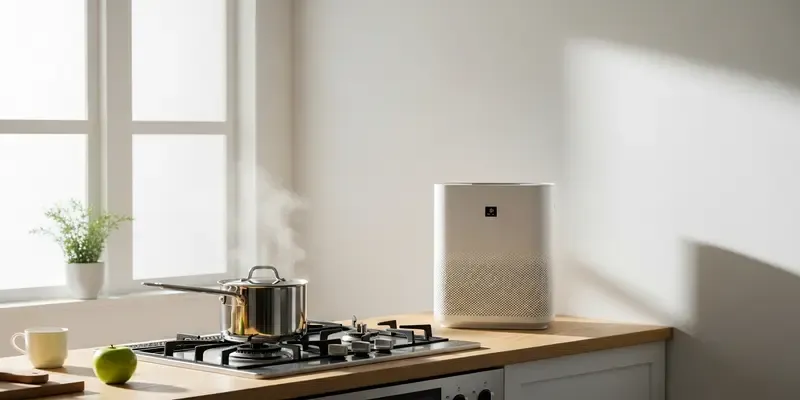
- The Simmer: Bring it to a low boil, then turn it down to a gentle simmer for exactly 20 minutes.
- The Assist: Run your air purifier on its highest setting simultaneously. The purifier catches the particulate matter while the vinegar steam neutralizes the gaseous odors.
Why Small Spaces Demand Better Solutions
In a 500-square-foot apartment, odors have nowhere to go. They embed themselves into your sofa, your curtains, and even your clean laundry. I learned this the hard way during my first year in a Brooklyn walk-up.
I had hosted a small brunch and made shakshuka. Three hours later, the smell of charred bell peppers and sulfurous eggs was so thick I could practically taste it. I felt trapped in my own home. I tried every spray in the cabinet until the air felt heavy and artificial. Finally, I remembered my grandmother’s trick. I dumped vinegar into a pot and let it steam. Within fifteen minutes, the ‘heavy’ feeling in the air lifted. The sharp vinegar scent was present for a moment, but then it vanished, taking the egg smell with it. My apartment finally felt like a home again, not a greasy spoon diner.
The Result: Real Air, Not Perfume
The beauty of this method is the ‘vanishing act.’ Unlike commercial air fresheners that linger for days, the scent of vinegar dissipates almost immediately after you turn off the heat. What’s left behind is simply… nothing. And in a world of over-processed scents, nothing is the ultimate luxury.
If you’re tired of smelling your Tuesday dinner on a Thursday morning, stop buying candles. Get a gallon of white vinegar, turn on your stove, and take back your space.
FAQs
Q: Does my kitchen smell like a pickle factory afterward? No. The vinegar scent is sharp while simmering, but it disappears completely within 10-15 minutes of turning off the stove, taking the bad odors with it.
Q: Can I use apple cider vinegar instead? You can, but white vinegar is superior. It has a higher acidity and no residual sugars, making it more effective and cleaner-smelling for this specific task.
Q: Is it safe for pets? Yes, in moderate amounts. Unlike many essential oils or synthetic fragrances which can be toxic to cats and dogs, diluted vinegar steam is generally safe for household pets.
Q: Do I need to keep the windows open? It helps, but it isn’t strictly necessary. If you have an air purifier, keep the windows closed to let the vinegar steam concentrate on the odors before the purifier scrubs the air.
Q: Can I add anything to the pot for a better smell? If you want a hint of fragrance, toss in a lemon slice or a cinnamon stick. However, for pure odor elimination, plain vinegar and water is the most powerful combo.
Q: How often can I do this? As often as you cook! It’s low-cost and chemical-free, making it a sustainable daily habit for avid home cooks.


