
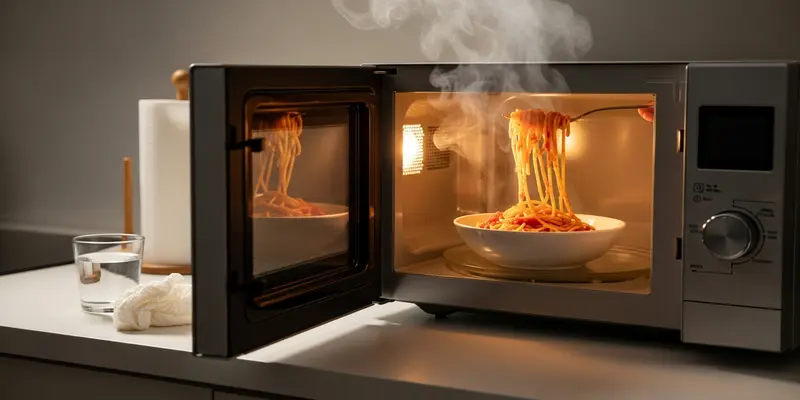
The Microwave is Not Your Enemy
Most people treat their microwave like a magic box where you press “Start” and hope for the best. It is not magic; it is physics. When you reheat starch, the water molecules vibrate so fast they escape as steam. Without intervention, your dinner becomes a desert. You aren’t just heating food; you are dehydrating it.
Dry rice is a choice, not a destiny. If you are pulling out bowls of tooth-shattering penne, you are doing it wrong. The microwave is a tool of convenience, but it requires a basic understanding of moisture management to produce something edible.
Enter the Splash Rule
The solution is deceptively simple. I call it the Splash Rule. Before you even think about hitting that start button, you need to reintroduce what the fridge stole: moisture.
- For Rice: Add exactly one tablespoon of water per cup of rice. Don’t drown it; just wake it up.
- For Pasta: Add a splash of water or a tiny knob of butter if the sauce is oil-based.
- The Seal: This is non-negotiable. Cover it tightly with a microwave-safe lid or a damp paper towel.
This creates a micro-steamer inside your appliance. You aren’t boiling the food again; you are reviving the starch granules with vapor. It’s the difference between a sad leftover and a meal that feels intentional.
A Lesson Learned in a Cold Kitchen
I learned this the hard way during a rainy winter in Seattle. I had a container of leftover mushroom risotto from a high-end bistro—expensive, delicious, and currently a cold, solid brick. I was exhausted, threw it in for two minutes on high, and walked away.
What emerged was a tragedy. The edges were literal glass, crunchy enough to chip a tooth, and the center was a cold, gelatinous lump. I tried to fix it with olive oil, but it just became a greasy, crunchy brick. I threw it out and started over with a cheap bag of white rice. That is when I tried the splash. A little water, a damp towel, and three minutes at 50% power. It came out fluffier than when it was fresh. I never looked back.
Stop Using Full Power
Here is the hill I will die on: Stop using the “High” setting for everything. High power is for boiling water or popping corn. For reheating, drop it to 50% or 60%. It takes a minute longer, but it prevents the edges from turning into carbon while the middle stays frozen. It allows the heat to distribute evenly, letting the steam do its job.
The Final Polish
Once the timer dings, let it sit. For thirty seconds, keep the lid on. This allows the residual steam to penetrate the very core of the grain or noodle. This is the patience phase. It’s the final step to ensuring every bite is as supple as the first. Stop settling for subpar leftovers. Use the splash, lower the power, and eat like a human being.
FAQs
Q: Can I use milk instead of water for pasta? A: Absolutely. If it is a creamy sauce like Alfredo, a splash of milk or heavy cream is actually superior to water for maintaining that velvety texture.
Q: Does this work for pizza too? A: No. Pizza needs a dry heat to keep the crust from turning into a sponge. Use a skillet or a toaster oven for pizza; the Splash Rule is for grains and pastas.
Q: How do I know if I added too much water? A: If there is a puddle at the bottom after stirring, you overdid it. Start with a teaspoon for smaller portions and scale up slowly.
Q: My rice is still clumpy. What now? A: You must break up the large clumps with a fork before you add the water and heat it. The steam can’t penetrate a solid wall of starch.
Q: Is a damp paper towel really necessary? A: Yes. It acts as a porous lid that traps the essential steam but prevents the pressure from building up and exploding your food all over the microwave.
Q: What about oily sauces like Aglio e Olio? A: Oil doesn’t evaporate like water. If your pasta is very oily, you need even less water—just a tiny spritz to keep the noodles supple without making them soggy.