
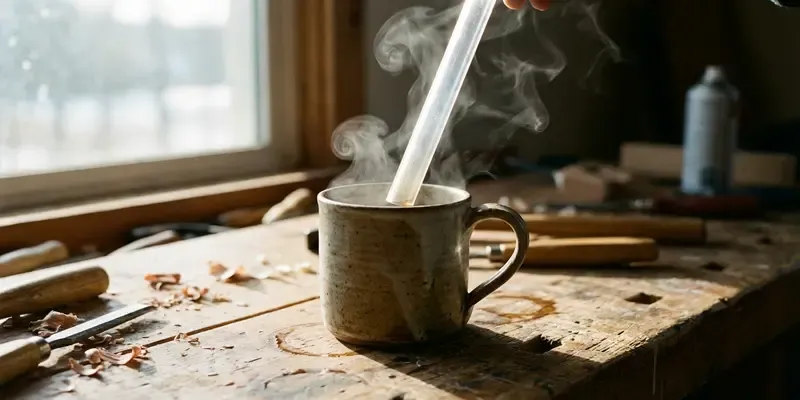
Stop Fighting Your Plumbing: The Hot Water Hose Hack
You are hunched over in a cramped bathroom, knuckles scraped and face turning a deep shade of crimson. You are currently losing a wrestling match against a three-inch piece of rigid plastic tubing. It won’t budge, the fitting is too wide, and you’re seconds away from throwing the entire bidet attachment out the window. This is the moment where most DIY dreams go to die, but it doesn’t have to be this way. The secret isn’t more muscle; it’s the 1990s ‘Dad Hack’ for DIY Plumbing.
Why Modern Plumbing Hates You
Most modern household appliances, from washing machines to bidet attachments, ship with hoses made of high-density polyethylene or stiff PVC. These materials are chosen for their durability and low cost, not for their ease of installation. They are notoriously stubborn.
When you try to force a cold, stiff hose onto a plastic barb, you risk two things: snapping the fitting or creating a micro-tear that leads to a slow, floor-rotting leak. Professional plumbers have expensive heat guns, but you don’t need one. You have a kettle.
The Physics of the ‘Hot Soak’
Plastics have a “glass transition temperature.” You don’t need to be a scientist to understand it; you just need to know that heat resets the material’s ego. By introducing controlled heat, you’re temporarily loosening the molecular bonds.
- Step 1: Heat a mug of water until it’s steaming, but not boiling. Boiling water (212°F) can actually deform some cheaper plastics permanently.
- Step 2: Submerge the end of the stiff hose for 30 to 45 seconds.
- Step 3: While it’s still pliable, slide it onto the fitting in one smooth motion.
- Step 4: Hold it in place for ten seconds. As the plastic cools, it shrinks and forms a literal “shrink-wrap” seal around the barb.
The Day the Bidet Almost Won
I learned this lesson the hard way in a cramped apartment back in 2014. I was trying to install a bidet to impress my partner, convinced that my “superior” grip strength was all I needed. After twenty minutes of grunting and sweating, I had managed to move the hose exactly zero millimeters. I was exhausted, the floor was wet, and my ego was bruised.
My father-in-law walked in, saw my trembling hands, and didn’t say a word. He walked to the kitchen, microwaved a coffee mug of water for two minutes, and brought it back. He dipped the hose, waited, and then pushed it onto the T-valve with the effort of someone closing a Ziploc bag. It was a humbling masterclass in finesse over force. That seal held for six years until we moved out.
Don’t Overthink It
We live in an era where people think every problem requires a specialized tool from a big-box store. We are sold lubricants, proprietary clamps, and expensive heat torches. But the best solutions are usually the ones that use what you already have in your kitchen.
Plumbing isn’t a battle of wills. It’s a negotiation with materials. When you use the hot water method, you aren’t just making the job easier—you’re ensuring a tighter, more reliable seal that will outlast the appliance itself. Stop fighting the plastic. Start working with it.
FAQs
Q: Should I use boiling water? No. Boiling water can cause the hose to lose its structural integrity or become too thin. Use water that is hot to the touch but not bubbling.
Q: Can I use a hair dryer instead? Yes, but it’s less efficient. Hot water provides even, 360-degree heat distribution instantly, whereas a hair dryer takes longer and can melt one side while the other stays cold.
Q: Does this work on braided metal hoses? No. This hack is specifically for the inner plastic tubing or solid plastic hoses. Braided lines have a metal exterior that won’t respond to this level of heat.
Q: Do I still need a hose clamp? Usually, yes. While the plastic shrinks as it cools, a hose clamp is necessary for high-pressure lines (like washing machines) to ensure the hose doesn’t pop off during a pressure spike.
Q: How long should I soak the hose? 30 to 60 seconds is the sweet spot. If it’s still stiff, give it another 30. If it feels like a cooked noodle, you’ve gone too far—let it cool slightly before trying again.
Q: Will this damage the fitting? Actually, it protects the fitting. Because the hose is soft, it slides on without requiring the lateral force that often snaps plastic intake valves on appliances.


