
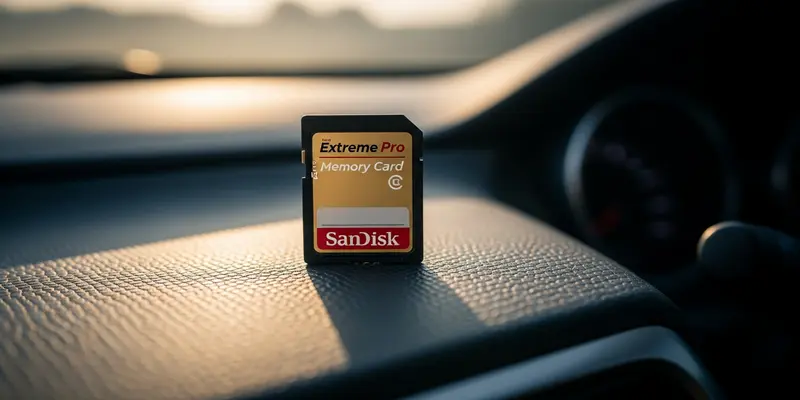
You’re driving home when a distracted teenager in a lifted truck clips your fender. No big deal, you think. You’ve got a dashcam. But when you pull the microSD card to show the police, the file is a 0KB ghost. Your dashcams and continuous recording setup didn’t save you; it failed you.
Most people treat SD cards like digital Tupperware—it doesn’t matter which one you use as long as it fits. That’s a lie. In the world of constant data overwriting, using a standard SD card in a dashcam isn’t just a mistake; it’s a countdown to data corruption.
The Silent Killer: Write Cycles
Memory cards aren’t infinite. Every time a card saves a video file, it uses up a tiny bit of its physical life. This is measured in P/E (Program/Erase) cycles. A standard card is designed for a photographer who shoots a hundred photos on a weekend.
Your dashcam is different. It is a data-shredding beast. It writes, deletes, and rewrites high-definition video every single second your engine is running. Standard cards use TLC (Triple-Level Cell) flash memory, which is cheap but fragile. They simply cannot handle the thermal stress and the relentless churn of “loop recording.”
- Total Bytes Written (TBW): This is the real metric of a card’s soul.
- Heat Sensitivity: Dashcams live on hot windshields. Standard cards melt internally.
- Voltage Drops: Cheap cards can’t handle the sudden power cuts when you turn off your car.
Why “High Endurance” is the Only Choice
When a manufacturer slaps a “High Endurance” label on a card, they (usually) aren’t just upselling you. These cards are typically built with MLC (Multi-Level Cell) or specially tuned 3D NAND flash. They are engineered to survive thousands of hours of constant writing.
Think of it this way: A standard card is a marathon runner in flip-flops. A high-endurance card is a soldier in combat boots. Both move forward, but only one is surviving the terrain. High-endurance cards have sophisticated “wear leveling” algorithms that spread data across the chip to ensure one single spot doesn’t get burnt out before the rest.
The Day the Footage Vanished
I learned this the hard way three years ago. I was parked at a grocery store during a summer thunderstorm. I heard the sickening crunch of plastic on metal. A silver SUV had backed into my door and sped off. I felt smug. I had a brand-new 128GB card from a bargain bin in my camera.
I took the card inside, the plastic still warm to the touch, and plugged it into my laptop. The folder was full of “File Corrupted” icons. The smell of rain was still fresh on my coat, but the evidence was gone. The constant heat of the sun combined with the high bitrate of the camera had literally cooked the card’s controller. I was out $500 for the deductible because I tried to save $15 on a memory card.
How to Buy the Right Card
Don’t look at the pretty colors on the packaging. Look at the specs. If you want your footage to be there when the ambulance arrives, follow these rules:
- Seek the Label: It must explicitly say “High Endurance.”
- Check the Warranty: Manufacturers often void the warranty of standard cards if used in a dashcam.
- Capacity Matters: A 128GB card will last longer than a 32GB card simply because it takes longer to complete a full write cycle.
- Class 10 / U3 / V30: Ensure it has the speed to handle 4K video without stuttering.
Summary: Stop Gambling with Your Safety
Your dashcam is an insurance policy. If you put a cheap card in it, you are essentially paying for a policy that might not pay out when you crash. Spend the extra money. Buy a reputable high-endurance card from brands like SanDisk, Samsung, or Transcend.
Check your footage once a month. Format the card in-camera every few weeks. Don’t wait for an accident to find out your memory card died six months ago.
FAQs
Q1: Can I use a standard Class 10 card for just a week? Technically, yes. But you are risking “write-lock,” where the card becomes read-only without warning. It’s a temporary fix, not a solution.
Q2: Why does my dashcam say “Memory Error” even with a new card? It might be a speed mismatch or a fake card. High-resolution cameras require high write speeds (V30 or higher) to keep up with the data flow.
Q3: How often should I replace a high-endurance card? Even the best cards die. For a daily driver, I recommend replacing your high-endurance card every 2 to 3 years as a preventative measure.
Q4: Does heat really affect SD card performance? Absolutely. Dashcams are often exposed to direct sunlight. High-endurance cards are tested for extreme temperatures (-25°C to 85°C).
Q5: Will a bigger card last longer? Yes. A 256GB card has twice the surface area for data than a 128GB card, meaning each individual cell is written to half as often.
Q6: Can I just format my cheap card to fix it? Formatting hides the problem by clearing the file table, but it doesn’t fix physical wear on the flash cells. Once a card starts failing, throw it away.