
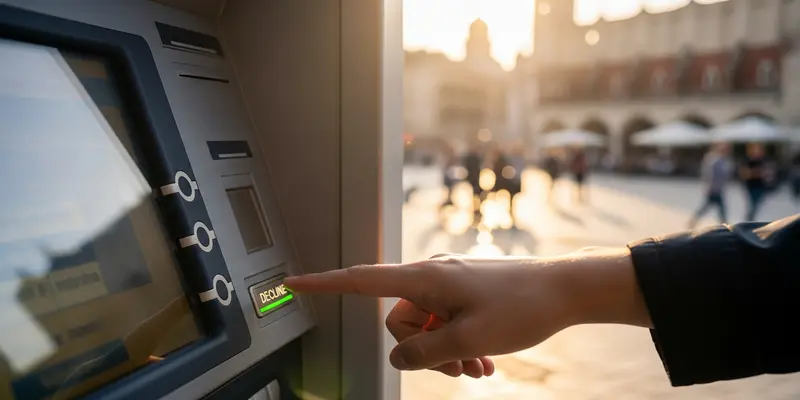
The ATM is lying to you. Not with words, but with a user interface designed by psychologists to exploit your jet lag. You’re standing in a bustling square, perhaps in Lisbon or Tokyo, just trying to get enough cash for dinner. Then it happens. The screen flashes a polite, helpful-looking question: "Would you like to be charged in your home currency for your convenience?" It feels like a safety net. It is actually a trap. This is the world of Dynamic Currency Conversion (DCC), and it is the single most expensive mistake travelers make. Understanding these ATM Withdrawal Secrets isn’t just about being frugal; it’s about refusing to be a victim of predatory banking.
The Legal Scam Known as DCC
Dynamic Currency Conversion is a service where the foreign bank offers to do the math for you. They show you exactly how many Dollars or Pounds will be deducted from your account. It sounds transparent. In reality, they are applying a massive markup—often 5% to 15%—above the actual mid-market rate.
When you see a screen offering a fixed exchange rate, you are looking at a sales pitch, not a service. The machine is essentially asking if it can take a fat commission for a calculation your own bank would do for free. Always choose the local currency. Let your home bank handle the conversion. They use the wholesale rate, which is almost always superior to the one the ATM is pushing.
The Psychology of the ‘Accept’ Button
Why do so many smart people fall for this? Because the buttons are colored to manipulate you. The "Accept Conversion" button is often bright green, large, and welcoming. The "Decline" or "Withdraw in Local Currency" button is frequently grey, small, or buried under a "More Options" menu.
- Green doesn’t mean go. In the world of foreign ATMs, green often means "give us your money."
- Convenience has a cost. Seeing your home currency feels safe, but that safety costs the price of a nice lunch.
- Trust your bank. Your card issuer (Visa or Mastercard) already has a system for this. You don’t need a third party to intervene.
The Trastevere Lesson
I learned this the hard way in 2019, standing in a narrow, cobblestone alley in Rome’s Trastevere district. I was exhausted, the smell of wood-fired pizza was distracting me, and I just wanted 200 Euros for a group dinner. The ATM offered me a rate of 1.18 USD to 1 EUR when the market rate was 1.10.
I did the quick math. Accepting their rate would have cost me nearly $20 extra for a single transaction. I paused. My finger hovered over the green button, but I remembered the golden rule. I hit "Decline Conversion." The machine let out a mechanical huff, spat out my Euros, and when I checked my bank statement later, I had been charged the fair market rate. That $20 difference paid for two bottles of house wine that night.
Take Your Power Back
Traveling should be about the experiences you gain, not the money you lose to a machine on a sidewalk. The solution is simple: be stubborn. Be the difficult customer that the ATM’s software wasn’t designed for.
Before you fly, check if your bank has international partners to avoid standard withdrawal fees. But regardless of the bank, the rule of the screen remains the same. When the machine asks to convert for you, say no. Hold your ground. Protect your travel budget one button-press at a time.
FAQs
1. Is it safe to decline the conversion?
Absolutely. When you decline, the transaction still goes through. It just means your home bank will decide the exchange rate rather than the foreign ATM’s owner.
2. What if the ATM says ‘Conversion Declined’ and cancels the transaction?
This is rare but happens at some predatory ATMs. If it happens, find a bank-affiliated ATM (like Santander, HSBC, or BNP Paribas) which are generally fairer than independent machines like Euronet.
3. Does this also apply to credit card machines in restaurants?
Yes. If a waiter asks if you want to pay in your home currency or the local currency, always choose the local currency (e.g., Euros in France, Yen in Japan).
4. What is the ‘mid-market rate’?
It is the real exchange rate—the midpoint between the buy and sell prices of two currencies. Banks use this for their own trades; DCC adds a heavy margin on top of it.
5. Why do ATMs offer this if it’s a bad deal?
Profit. The ATM operator keeps the margin they charge you. It’s a massive revenue stream for independent ATM networks.
6. Should I use an ATM or a currency exchange booth?
ATMs are almost always better than exchange booths, provided you decline the conversion. Booths in airports have some of the worst rates in the world.