
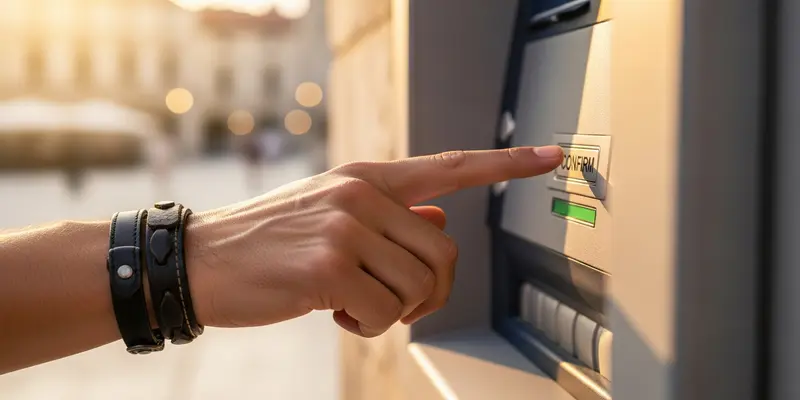
You’re standing in a bustling plaza in Rome, the scent of espresso in the air, and you need cash for a gelato. You find an ATM, slide in your card, and suddenly the screen presents a choice that looks like a courtesy but feels like a trap. It offers to “Lock in your exchange rate” or Withdraw Without Conversion. If you choose wrong, you’ve just handed over the price of a full Italian dinner to a bank you don’t even belong to.
The Illusion of Convenience
Dynamic Currency Conversion (DCC) is a predatory practice disguised as a service. The machine offers to do the math for you, showing you exactly how much will be deducted from your home account in your native currency. It sounds safe. It sounds transparent. It is a lie.
When you accept the ATM’s conversion, you aren’t getting the market rate. You are getting a rate padded with a 5% to 13% markup. The machine is essentially asking, “Would you like to pay an extra $15 for the privilege of seeing a number you already understand?” The answer should always be a resounding no.
Why the Machine is Not Your Friend
Banks rely on your fear of the unknown. They bank on the fact that you don’t know the exact exchange rate of the Bulgarian Lev or the Vietnamese Dong at that exact second. They offer “peace of mind” at a premium that would make a loan shark blush.
- The Markup: DCC rates are consistently worse than what your own bank will give you.
- Double Dipping: Often, the ATM owner charges a flat fee plus the hidden conversion percentage.
- The Choice: By choosing the local currency, you force your home bank to handle the conversion at the interbank rate.
My $40 Lesson in Lisbon
I learned this the hard way on a windy night in Lisbon. I was tired, hungry, and the smell of grilled sardines from a nearby tasca was distracting me. I needed 200 Euros. The ATM screen flashed a “Guaranteed Rate” that would charge my US account $252. I was exhausted and hit “Accept.”
Later that night, over a glass of green wine, I did the math. Had I hit “Decline Conversion,” my bank would have charged me roughly $214. That one button press cost me nearly $40—the price of my entire dinner and then some. I felt the slick, thermal paper of the receipt in my hand and promised never to let a machine intimidate me into a bad deal again. From that day on, I’ve treated every ATM screen like a negotiation I intend to win.
How to Fight Back at the Terminal
Winning this game is remarkably simple. You don’t need to be a math genius; you just need to be stubborn.
- Always Choose Local: If you are in Mexico, choose Pesos. In Japan, choose Yen. In the UK, choose Pounds.
- Ignore the Warnings: The ATM might warn you that “the exchange rate is not guaranteed” or that “your bank may charge additional fees.” This is a scare tactic. Ignore it.
- Check the Screen: Look for the button that says “Withdraw Without Conversion” or “Decline Conversion.”
By keeping the transaction in the local currency, you are utilizing the global banking network’s efficiency rather than a single ATM’s greed. Your travel budget belongs to you—keep it that way.
FAQs
Q: What exactly is Dynamic Currency Conversion (DCC)? A: It’s a service where a foreign merchant or ATM offers to convert a transaction into your home currency on the spot, usually at a terrible rate.
Q: Is it ever better to accept the ATM’s conversion? A: Almost never. In 99% of cases, your home bank will give you a significantly better exchange rate than the ATM provider.
Q: What if the ATM says it can’t guarantee the rate? A: That’s fine. Your bank’s “un-guaranteed” rate is still going to be much closer to the real market value than the ATM’s predatory “guaranteed” rate.
Q: Does ‘decline conversion’ mean I won’t get my money? A: No. It just means the ATM will process the request in the local currency and let your bank handle the math.
Q: Should I use credit cards or debit cards at foreign ATMs? A: Always use a debit card to avoid high “cash advance” interest rates from credit cards, but the rule about declining conversion applies to both.
Q: How can I avoid ATM fees entirely? A: Look for banks that offer worldwide ATM fee reimbursements, like Charles Schwab in the US or similar digital-first banks globally.