
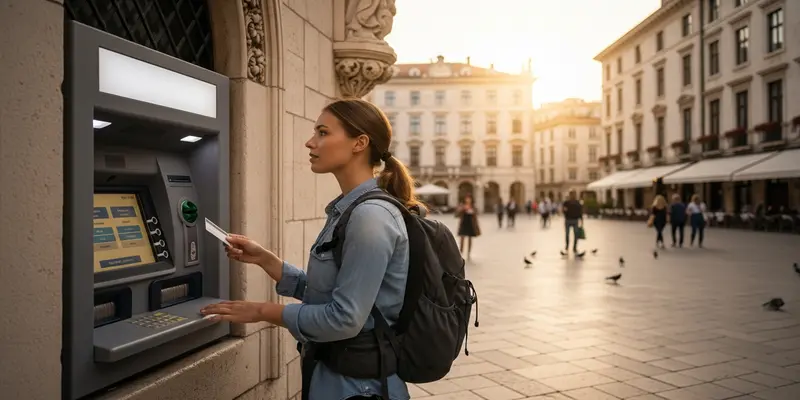
You’re in a bustling market in Rome, the smell of fresh basil and leather filling the air. You need cash for a gelato. You find an ATM, slide in your card, and the screen offers you a “guaranteed exchange rate.” It looks safe. It looks convenient. It’s a total ripoff.
Every time you travel, you face a digital gatekeeper at the ATM. It asks if you want to Withdraw without conversion or accept their conversion rate. Most people, fearing the unknown fluctuations of the market, click “Accept.” They are paying for a peace of mind that costs them 10% to 15% of their money. Let’s stop doing that.
The Illusion of the “Guaranteed” Rate
Banks call this Dynamic Currency Conversion (DCC). It sounds professional, but it’s essentially a high-interest payday loan you didn’t ask for. The machine offers to show you exactly how much your home currency will be debited.
- The Trap: The ATM owner sets an arbitrary, inflated exchange rate.
- The Hidden Fee: They often tack on an additional “service fee” for the privilege of overcharging you.
- The Reality: Your home bank almost always has a better rate.
Why Your Own Bank is Your Best Ally
When you choose “Withdraw without conversion,” you are telling the ATM to send the transaction to your home bank in the local currency (Euros, Yen, Pesos). Your bank then uses the wholesale market rate—the same one big corporations use—to do the math.
Even with a small foreign transaction fee, you’ll beat the ATM’s rate every single time. It’s the difference between a fair trade and a highway robbery. Trust the system you already pay for, not the machine in a dark corner of a train station.
The Rainy Night in Shinjuku
I learned this the hard way in Tokyo. It was 11 PM, I was jet-lagged, and the rain was hammering against the glass of a 7-Eleven. I needed 50,000 Yen. The ATM offered to convert it for me, showing a nice, round number in USD. I was tired and wanted to get to my hotel. I hit “Accept.”
Later that night, I did the math. By letting the ATM handle the conversion, I had paid nearly $45 more than if I’d just let my bank do the work. I felt like I’d been pickpocketed by a computer. That $45 could have been a spectacular sushi dinner. Now, I never click “Accept”—and neither should you.
How to Beat the Machine
The interface is designed to confuse you. You might see buttons labeled “Continue with Conversion” in bright green and “Continue without Conversion” in a dull grey. Do not be fooled by the UI design.
- Look for the Local Currency: Always select the option that keeps the transaction in the local currency.
- Reject the Rate: If the screen shows a conversion rate, it’s almost certainly a bad deal.
- Stay Calm: Take three extra seconds to read the fine print before pressing a button.
Conclusion
Travel is expensive enough without handing over your hard-earned cash to a greedy ATM network. By simply choosing to Withdraw without conversion, you keep your money where it belongs: in your pocket. The next time you see that screen, remember: the “safe” choice is the one where you say no.
FAQs
Q: What happens if I choose ‘Withdraw without conversion’?
A: Your bank at home will handle the currency exchange using their standard (usually much better) rate.
Q: Is it ever better to accept the ATM’s conversion?
A: Almost never. In 99% of cases, your home bank provides a superior exchange rate compared to the ATM owner.
Q: Why do ATMs offer this service if it’s bad for customers?
A: Profit. The ATM owner and the processing network split the massive markup they charge you for the conversion.
Q: Does this apply to credit card terminals in shops too?
A: Yes. If a shop asks if you want to pay in USD or the local currency, always choose the local currency.
Q: What if I don’t know my bank’s exchange rate?
A: Even if you don’t know the exact rate, major networks like Visa and Mastercard use rates very close to the mid-market price.
Q: Are there specific ATMs I should avoid?
A: Independent ATMs in high-traffic tourist areas (like Euronet in Europe) are notorious for aggressive conversion prompts and high fees.