
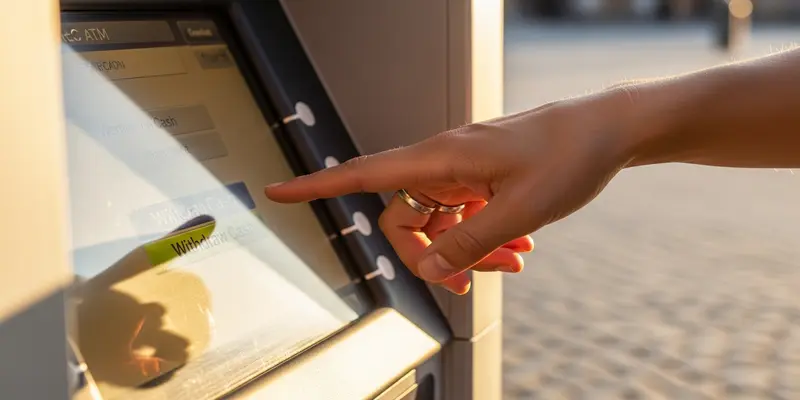
You are standing in a crowded terminal, jet-lagged and desperate for local cash. You find a machine, slide your card in, and enter your PIN. Suddenly, the screen presents a choice: “Accept Conversion” or “Decline Conversion.” It looks like a polite offer to help you understand the math in your own currency.
Don’t fall for it. This is The ATM ‘Conversion’ Trap, a predatory practice known as Dynamic Currency Conversion (DCC). It is designed to siphon money from your pocket directly into the bank’s profit margins under the guise of convenience.
The Illusion of Certainty
Banks love to play on your fear of the unknown. By offering to show you exactly how much your withdrawal costs in your home currency, they are selling you “certainty.” But that certainty comes at a staggering price.
- Predatory Rates: The ATM’s internal exchange rate is almost always significantly worse than the mid-market rate.
- Hidden Fees: On top of the bad rate, they often bake in a 5% to 13% markup.
- Double Dipping: You might still be charged a foreign transaction fee by your own bank on top of the ATM’s inflated conversion.
When you choose “Without Conversion,” you are telling the machine to bill your home bank in the local currency. Your bank—which actually wants to keep you as a customer—will then handle the conversion at a much fairer, competitive rate.
How to Spot the Scam
The ATM software is designed by psychologists, not just programmers. The buttons for “Accept Conversion” are often larger, brighter, or highlighted in green. The “Decline” or “Without Conversion” option might be small, gray, or accompanied by a scary warning saying the rate is “not guaranteed.”
Ignore the warnings. The only thing “guaranteed” if you accept is that you are overpaying for your own money.
A Lesson Learned in Lisbon
I learned this the hard way on a rainy Tuesday in Lisbon. I was rushing to pay a landlord who only took cash and stopped at a bright yellow Euronet machine. The screen offered to convert my 200 Euro withdrawal into 245 US Dollars. It sounded roughly correct in my tired brain, so I hit “Accept.”
Later that night, over a glass of Vinho Verde, I checked my banking app. If I had simply declined the conversion, that same 200 Euros would have cost me 222 Dollars. I had essentially handed the machine 23 Dollars—the price of a full seafood dinner—for absolutely nothing in return. Since then, I treat that “Accept” button like it’s radioactive.
The Golden Rule of Travel
Always, without exception, choose to be charged in the local currency. Whether it’s an ATM in Tokyo, a boutique in Paris, or a restaurant in Mexico City, the rule remains the same. If a machine asks if you want to pay in your “Home Currency” or the “Local Currency,” the local option is the only path to a fair deal.
FAQs
1. What happens if I click ‘Decline Conversion’? Your withdrawal still goes through perfectly. The foreign bank simply sends a request to your home bank for the local amount, and your bank does the math at a better rate.
2. Is it safe to decline the conversion? Yes. It is a standard banking procedure. The scary warnings on the screen are just marketing tactics to trick you into paying more.
3. Why do banks offer this if it’s a bad deal? Because it is incredibly profitable. Dynamic Currency Conversion generates billions in pure profit for banks and ATM operators globally.
4. Does this apply to credit card terminals too? Absolutely. If a waiter or shopkeeper asks if you want to pay in Dollars instead of the local currency, always say “Local currency, please.”
5. Which ATMs are the worst offenders? Independent ATMs, like those found in convenience stores or branded as ‘Euronet,’ typically have the highest markups. Try to use machines attached to major national banks.
6. How else can I save on fees? Use a bank card that offers “No Foreign Transaction Fees” and reimburses ATM operator fees. This, combined with declining conversion, makes your money go much further.