
Fix Your 'Broken' Grill Igniter for $2
You turn the gas on. You press the button. Silence. No clicking, no spark, nothing but the faint hiss of propane and the growing realization that you might have to go hunting for that long-reach lighter you lost last summer. Most people assume their gas grill igniter has suffered a catastrophic mechanical failure. They prepare to buy a new part or, worse, resign themselves to a lifetime of singed arm hairs.
Stop. Your grill isn’t dying. It’s likely just out of juice. We live in a disposable culture that would rather replace an entire appliance than look for a hidden compartment. But if your grill button feels soft or doesn’t make that rapid-fire clicking sound, the solution is usually a two-dollar battery hidden in plain sight.
The Great Igniter Scam
Manufacturers aren’t necessarily trying to trick you, but they aren’t shouting the solution from the rooftops either. Many modern gas grills use a battery-powered pulse ignition system. It’s more reliable than the old friction-based clickers, until the battery dies.
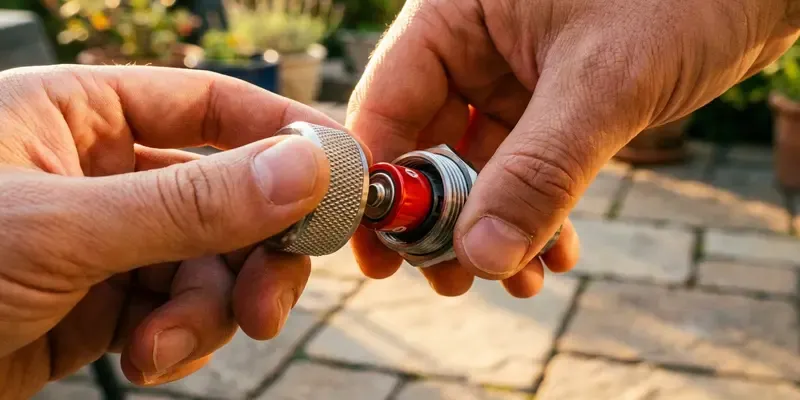
Because the button itself is often encased in a rubberized weather-cap, it looks like a sealed unit. It isn’t. In about 90% of cases, that button is actually a screw-cap.
- The Fix: Unscrew the ignition button counter-clockwise.
- The Reveal: A single AA or AAA battery will pop out.
- The Solution: Swap it for a fresh one, screw the cap back on, and watch the sparks fly.
Why We Give Up Too Fast
We’ve been conditioned to think that if something doesn’t work, it’s a “tech issue.” We blame the wiring or the electrodes. We see a bit of rust on the flavorizer bars and assume the whole rig is toast.
This is a waste of money and resources. A gas grill is a remarkably simple machine. It’s just tubes, valves, and a spark. If you have gas and you have a spark, you have dinner. Don’t let a dead $2 battery convince you to drop $600 on a new Weber.
The Night I Almost Ate Raw Steak
I remember July 4th, 2019. I had four thick ribeyes seasoned and coming to room temperature. The patio was crowded, the beer was cold, and the pressure was on. I hit the igniter. Nothing.
I felt that immediate spike of “handyman shame.” I spent ten minutes digging through junk drawers for a match, getting more frustrated by the second. I could smell the propane, but I couldn’t get a flame. Just as I was about to give up and pan-sear them inside—ruining the vibe—I remembered a tip from an old neighbor. I twisted the rubberized button. It clicked open. A corroded AA battery fell into my palm like a shameful secret. I stole a battery from the TV remote, popped it in, and the grill roared to life on the first click. The steaks were saved, and my ego remained intact.
Keep the Spark Alive
Once you’ve replaced the battery, do yourself a favor: check the electrodes. If the battery is fresh but the spark is weak, take a small wire brush or some sandpaper to the tip of the igniter probe near the burner.
Grease and carbon buildup act as insulators. A quick scrub takes ten seconds and ensures that the spark actually jumps to the gas rather than dying on a pile of charred hamburger drippings. Maintenance shouldn’t be a chore; it’s just the price of admission for perfect BBQ.
Conclusion
Stop reaching for the manual lighter. Your grill was designed to be convenient, so make it work for you. Go outside, unscrew that button, and see if a simple battery swap changes your life. It’s the easiest win you’ll have all week.
FAQs
Q: How do I know if my igniter uses a battery? If it makes a rapid ‘tick-tick-tick’ sound when it works, it’s battery-powered. If it makes one loud ‘clack,’ it’s likely a piezoelectric starter which doesn’t use batteries.
Q: What if the button doesn’t unscrew? Check behind the control panel. Some models have a separate battery box tucked underneath or inside the cabinet door.
Q: Why does my battery keep dying so fast? Moisture is the enemy. Ensure the rubber cap is screwed on tightly to prevent rain from seeping into the contacts and causing a slow drain.
Q: Can I use rechargeable batteries in my grill? Yes, but standard alkaline batteries often handle the extreme outdoor temperature fluctuations better than NiMH rechargeables.
Q: There is a clicking sound, but no flame. Now what? Clean the burner ports near the igniter. If the gas can’t reach the spark because the holes are clogged with grease, it won’t light.
Q: Is it dangerous to change the battery while the gas is on? Always turn off your gas tanks before fiddling with the ignition system. Safety first, steak second.


