
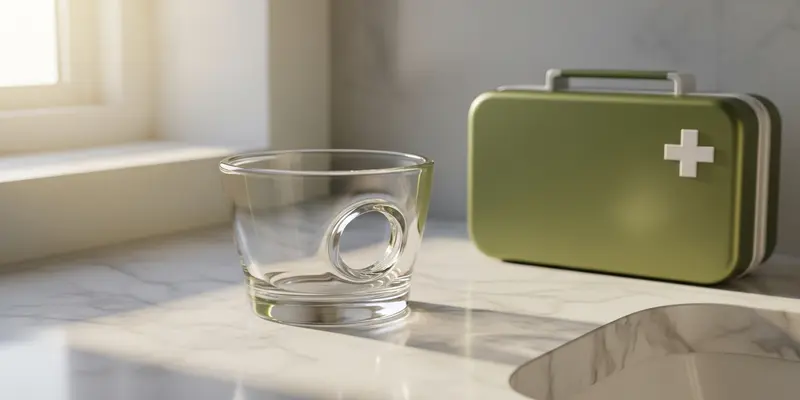
You’re working in the garage, or maybe just cleaning a high shelf. Suddenly, it happens. A speck of grit, a splash of cleaner, or—as one Reddit user recently discovered—a razor-sharp metal shaving finds its home on your cornea. Panic sets in. You stumble to the sink, splashing cold water haphazardly, but the irritation remains. This is where most people fail. You don’t need a miracle; you need an eye wash cup.
The Fatal Flaw in Your First Aid Kit
Look at your current kit. You’ve got bandages for days. You’ve got antiseptic wipes and probably some expired aspirin. But if something toxic or sharp enters your eye, those tools are useless. Most people assume they’ll just use the shower or the sink, but that’s a recipe for a scratched cornea.
An eye wash cup is the most underrated tool in the home medical cabinet. It’s not just “nice to have.” It’s the difference between a minor irritation and a permanent scar on your vision. Here is why it wins every time:
- Precision: Unlike a running faucet, a cup creates a vacuum-like seal around the eye.
- Control: You can blink into the solution, allowing the liquid to reach behind the lids where debris hides.
- Safety: It prevents you from rubbing—the absolute worst thing you can do when metal or glass is present.
Stop Using the Sink
We’ve all done it. We cup our hands and splash. It’s messy, inefficient, and often introduces more bacteria into the eye. A dedicated eye wash cup, paired with sterile saline, is a controlled environment.
When you use a sink, you’re fighting your own blink reflex. The cup bypasses that. By tilting your head back and opening your eye into the fluid, you allow physics to do the heavy lifting. It’s a gentle, consistent flush that dislodges particles without the trauma of high-pressure tap water.
A Lesson from the Workshop
A few years ago, I was stripping old paint off a vintage chair. I was wearing “safety glasses,” but they weren’t goggles. A tiny flake of dried, chemical-laden lead paint bypassed the frame and wedged itself under my upper eyelid. The pain was immediate and hot.
I didn’t have a cup. I spent twenty minutes screaming at my bathroom mirror, trying to use a wet Q-tip and cupped hands. I ended up in the urgent care with a scratched cornea and a $400 bill. If I had spent $5 on a plastic eye wash cup and kept a bottle of saline nearby, that flake would have been gone in thirty seconds. Now, I keep one in the bathroom, one in the garage, and one in my hiking pack.
How to Use It Properly
- Fill it up: Use sterile saline solution, not just tap water, to avoid “acanthamoeba” or chlorine irritation.
- Lean in: Lean your head forward and press the cup firmly against your eye socket to create a seal.
- The Tilt: Tilt your head back slowly while keeping the cup sealed against your skin.
- The Blink: Blink repeatedly and roll your eye in circles. Let the fluid work its way behind the debris.
Conclusion
Don’t wait for a “metal shaving” moment to realize your kit is incomplete. Go to the pharmacy today. Buy two eye wash cups and a fresh bottle of sterile saline. It’s a five-dollar investment that could literally save your sight. Stop gambling with your eyes and start preparing for the inevitable.
FAQs
Q: Can I just use a shot glass? A: In an absolute pinch, yes, but a real eye wash cup is contoured to fit the orbital bone, creating a seal that a flat shot glass can’t provide.
Q: Is tap water okay to use? A: Tap water contains minerals and sometimes microorganisms. Sterile saline is always preferred to avoid infection or further irritation of the delicate eye tissue.
Q: How often should I replace the solution? A: Check the expiration date on your saline bottle. Once opened, many brands should be discarded after 30-90 days to ensure sterility.
Q: Do I need one if I wear glasses? A: Yes. Glasses are not sealed. Dust, chemicals, and debris easily fly over or around the lenses, especially during yard work or DIY projects.
Q: What if the object is stuck? A: If a flush doesn’t work after two minutes, stop. Cover the eye with a clean pad and go to the ER immediately. Never attempt to dig an object out with a tool.
Q: Should I use it for “red eye”? A: It can help flush out allergens like pollen or dust, but it won’t cure a viral or bacterial infection like pink eye. See a doctor for persistent redness.