
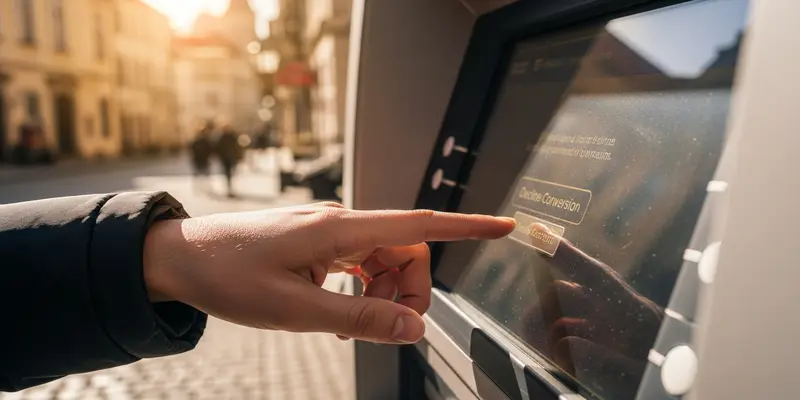
You are standing in a bustling plaza in Lisbon. The air smells of grilled sardines and sea salt. You need cash for a small ceramic shop that doesn’t take cards. You find an ATM, insert your card, and suddenly, a polite screen appears: "Would you like to be charged in your home currency?". It looks helpful. It looks safe. It’s the most expensive mistake you’ll make all day.
The Illusion of Certainty
This phenomenon is called Dynamic Currency Conversion (DCC). It is a wolf in sheep’s clothing. The ATM is offering you the ‘convenience’ of knowing exactly how much will be deducted from your bank account in dollars, pounds, or euros. But that certainty comes at a staggering price.
When you accept the conversion, the ATM operator—not your home bank—sets the exchange rate. They aren’t doing this to be nice. They are doing it to skim a massive margin off the top. I have seen markups as high as 12% over the mid-market rate. For a $200 withdrawal, you might be throwing $24 straight into a billionaire’s pocket for absolutely no reason.
Why Your Bank Does it Better
If you decline the conversion, the ATM processes the transaction in the local currency. Your home bank then handles the conversion. Here is why this is the only logical choice:
- Competitive Rates: Major banks and credit card networks (Visa/Mastercard) use rates very close to the actual market value.
- Transparency: You might have a 1% or 3% foreign transaction fee, but that is still far cheaper than the 10% hidden in a DCC rate.
- No Hidden Margins: You avoid the ‘convenience fee’ baked into the exchange rate by the local machine.
The Mexico City Mugging
I learned this the hard way in Mexico City. I was in a rush, a line of impatient locals forming behind me at a crowded bank in Polanco. The screen flashed a conversion rate that looked slightly ‘off,’ but I was sweaty, tired, and just wanted my pesos. I hit ‘Accept.’
Later that night, over tacos, I did the math. By choosing the ‘guaranteed’ rate, I had effectively paid for an extra five dinners in fees alone. It felt like being legally mugged. The screen had used words like ‘guaranteed’ and ‘fixed’ to prey on my travel fatigue. Never again. Since then, I have treated the ‘Accept Conversion’ button like a ‘Donate to a Bank CEO’ button.
How to Win the Game
It is simple: Always choose the local currency. If you are in Japan, choose Yen. If you are in Switzerland, choose Francs. If you are in the UK, choose Pounds.
When the ATM asks, "Proceed with conversion?". Press No. When it asks, "Continue without conversion?". Press Yes. It feels counterintuitive because the machine often uses scary red text or warnings about ‘unknown exchange rates’ to spook you. Ignore them. Your home bank is your ally; the foreign ATM is a salesperson.
Keep Your Money for Memories
Travel is about discovery, not subsidizing predatory banking practices. By making this one small choice at the terminal, you preserve your travel budget for things that actually matter—like that extra bottle of wine or a better hotel room. Take control of your currency, refuse the bait, and keep your hard-earned cash where it belongs: in your pocket.
FAQs
Q: What happens if I decline the conversion at an ATM? Your transaction will be processed in the local currency, and your home bank will handle the conversion at their standard (usually much better) rate.
Q: Why do ATMs offer Dynamic Currency Conversion if it’s bad for me? It is a massive profit center for the ATM owners and the local banks. They rely on travelers choosing ‘certainty’ over doing the math.
Q: Does this apply to credit card terminals in shops and restaurants too? Absolutely. If a waiter or shopkeeper asks if you want to pay in your home currency, always say no. Always pay in the local currency.
Q: Is it ever better to accept the conversion? Almost never. Unless your home bank has astronomical, predatory foreign fees (which is rare), the local currency option is cheaper 99.9% of the time.
Q: What if the ATM says ‘Transaction may be subject to additional fees’ if I decline? This is often a scare tactic. While the ATM may charge a flat usage fee, the conversion markup is a separate, hidden cost you should always avoid.
Q: How can I avoid ATM fees entirely? Look for banks with global partnerships or get a travel-specific debit card (like Charles Schwab or various digital banks) that reimburses all global ATM fees.