
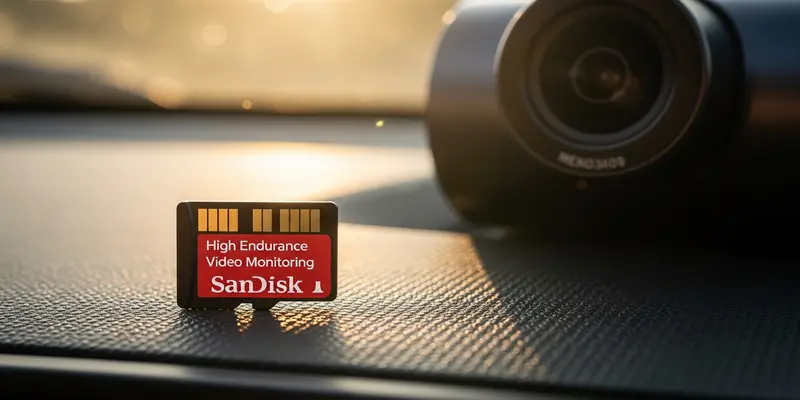
You’re driving home when a distracted driver clips your fender and speeds off. You breathe a sigh of relief because you have a dashcam. But when you get home and plug that card into your computer, the folder is empty. Or worse, the file for the last ten minutes is a pixelated, unreadable mess.
This isn’t a glitch. It’s a hardware murder. You’ve been using High-Endurance and Standard SD Cards interchangeably, and your dashcam just killed the latter.
The Hidden War Inside Your Windshield
Most people think an SD card is just a bucket for data. In reality, it’s more like a notebook. Standard cards are designed for cameras or phones—devices that write a little data, then stop.
Dashcams are different. They are data-writing monsters. They record, delete, and overwrite every single minute the engine is running. This constant loop creates immense heat and physical wear on the microscopic gates of the flash memory.
Standard cards use Triple-Level Cell (TLC) technology that wasn’t built for this marathon. They have a limited number of “write cycles.” In a dashcam, a cheap card can reach its deathbed in as little as three months.
Why Standard Cards Fold Under Pressure
When a standard card starts to fail, it doesn’t send you a warning. It just stops recording.
- Heat Sensitivity: Dashcams sit behind glass in the direct sun. Standard cards warp and fail in high temperatures.
- Write Fatigue: The internal controller on a basic card gets overwhelmed by the 24/7 loop, leading to “ghost files.”
- Voltage Fluctuations: Cheap cards can’t handle the tiny power dips that happen when you start or stop your car.
The Night My Cheap Card Cost Me $1,500
I learned this lesson the hard way on a rainy Tuesday in Seattle. A white delivery van backed into my parked car while I was grabbing coffee. I saw it happen through the window. I wasn’t worried; I had a 128GB “Ultra” card from a reputable brand that I’d bought on sale.
When I pulled the footage, the card was bricked. The dashcam had been trying to write over a bad sector for weeks, and the card simply locked itself into “Read Only” mode to prevent further damage. I had zero evidence. I paid my $1,500 deductible out of pocket because I tried to save $15 on a memory card.
The High-Endurance Advantage
High-endurance cards use different NAND flash (often MLC or specially binned TLC) and superior controllers. They are designed specifically for high-intensity write environments.
They don’t just last longer; they fail gracefully. A true high-endurance card can often withstand 5,000 to 20,000 hours of continuous recording. That is the difference between a card that lasts a summer and one that lasts the life of your car.
How to Choose Your Next Card
Don’t look at the “speed class” alone. A V30 or Class 10 rating tells you how fast it is, but not how tough it is.
- Look for the “Endurance” Label: Brands like Samsung (Pro Endurance) and SanDisk (Max Endurance) specifically engineer these for dashcams.
- Check the Warranty: Standard cards often explicitly state their warranty is VOID if used in a dashcam. High-endurance cards carry a multi-year dashcam-specific warranty.
- Format Regularly: Even a great card needs a clean slate. Format your card inside the dashcam once a month to keep the file system healthy.
Your dashcam is your silent witness. Don’t give it a cheap voice that will fail when you need it to scream.
FAQs
Q: Can I use a standard 256GB card instead of a 64GB endurance card? No. While higher capacity can spread the wear out, the underlying tech in a standard card still can’t handle the heat and constant cycles like an endurance card can.
Q: Why does my dashcam say “Memory Error” even with a new card? You likely have a card that is too slow or isn’t high-endurance. Your dashcam’s processor is trying to write data faster than the card can handle.
Q: How often should I replace a high-endurance SD card? Even the best cards have a lifespan. Generally, replace your high-endurance card every 2–3 years if you drive daily.
Q: Does formatting the card fix bad sectors? It can temporarily bypass them, but if your card is throwing errors, it’s physically wearing out. Formatting won’t fix dying hardware.
Q: Are expensive cards always high-endurance? Not at all. Many expensive “Extreme Pro” cards are optimized for burst photography, not continuous video loops. Always look for the word “Endurance.”
Q: Is it okay to leave the card in the dashcam during summer? High-endurance cards are rated for higher temperatures, but if you’re parked in 100°F heat for days, no card is invincible. Try to park in the shade whenever possible.