
You are driving home when a sedan swerves into your lane, clipping your bumper. You’re calm. You have a dashcam. But when you get home and plug that card into your computer, your heart sinks. The folder is empty, or worse, the file says ‘Format Error.’ Your Dashcam Footage Is Corrupted right when you needed it most.
This isn’t a glitch in the camera. It’s a failure of the one component most drivers ignore: the SD card. Most people grab whatever ‘Extreme’ or ‘Gold’ card is on sale at the big-box store. That is a massive, expensive mistake.
The Overwrite Death Loop
Dashcams are torture chambers for flash memory. Unlike a DSLR where you take a few photos and then dump the files, a dashcam is constantly writing. It records in a loop, writing over the oldest data the second the card hits capacity.
Standard SD cards use a technology called TLC (Triple-Level Cell) flash. It’s cheap and great for occasional use, but it has a very limited number of ‘write cycles.’ When you force a standard card to overwrite itself thousands of times in the heat of a windshield, the cells literally wear out. They die. And they take your evidence with them.
The Myth of Speed Classes
You see ‘Class 10’ or ‘U3’ and think you’re safe. You aren’t. Those ratings are about speed, not durability. A Ferrari is fast, but it wasn’t built to haul gravel 24 hours a day. High-speed cards are built for bursts; high-endurance cards are built for the marathon.
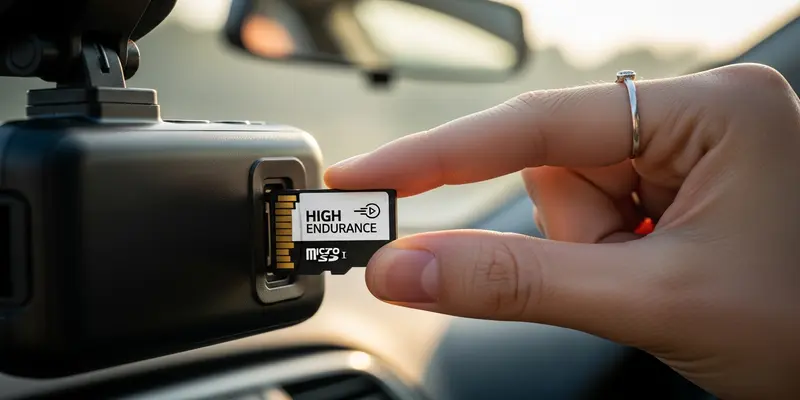
If you aren’t using a card specifically labeled ‘High Endurance,’ you are playing Russian Roulette with your insurance claim. These specialized cards use superior NAND flash and controllers designed to handle the ‘always-on’ nature of automotive recording.
The Day I Lost Everything
I learned this lesson the hard way on a slick Tuesday in November. I was driving through downtown, the smell of damp asphalt and car exhaust filling the air. A delivery truck backed into me at a red light and then simply drove off.
I wasn’t worried. I had a top-tier ‘Pro’ card in my dashcam. But when I got home, the card felt unusually hot to the touch. When I opened the files, the video from the actual impact was a jagged mess of green pixels. The card had reached its write limit three days prior and had been silently failing ever since. I was out $1,200 for a new bumper because I tried to save $15 on a memory card.
How to Choose a Survivor
Don’t look for the biggest storage number or the highest speed rating. Look for these three things:
- High Endurance Label: If it doesn’t say it on the packaging, don’t buy it.
- Temperature Resistance: Dashcams sit in direct sunlight. Your card needs to be rated for extreme heat.
- Warranty Awareness: Did you know most standard SD card warranties are voided if used in a dashcam? Check the fine print. High Endurance cards are the only ones backed for this specific use.
Conclusion
A dashcam is only as good as the medium it writes to. Stop treating your memory card like a disposable accessory and start treating it like the critical safety device it is. Go to your car, pull out that standard card, and replace it with a High Endurance model today. It’s the cheapest insurance you’ll ever buy.
FAQs
Q: Can I just use a larger 256GB standard card instead?
A: No. While a larger card takes longer to fill up, the internal components are still not designed for the constant heat and stress of a dashcam environment.
Q: How often should I format my dashcam SD card?
A: Even with a High Endurance card, you should format it inside the camera every 30 days to clear out file system errors and maintain health.
Q: What is the typical lifespan of a High Endurance card?
A: Depending on your driving habits, a good High Endurance card should last 2 to 5 years, whereas a standard card might fail in 6 months.
Q: Why does the card feel hot when I take it out?
A: Constant data writing generates friction at the molecular level. High Endurance cards are built to dissipate this heat without melting the internal circuits.
Q: Will a High Endurance card improve my video quality?
A: Not directly, but it prevents ‘dropping frames’ and digital artifacts that occur when a standard card can’t keep up with the data stream.
Q: Is it okay to buy these cards from any online seller?
A: Be careful. The market is flooded with fakes. Only buy from reputable retailers to ensure you’re getting genuine high-endurance NAND flash.