
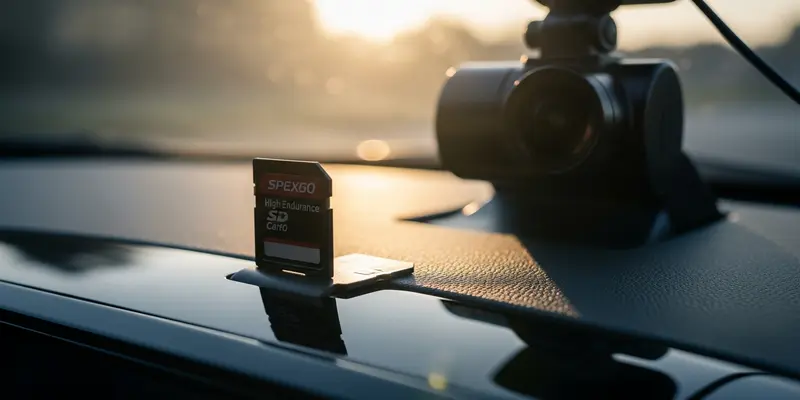
You’re driving home when a silver sedan clips your bumper and speeds off. You aren’t worried. You have a dashcam. But when you pull the card later that night, the folder is empty. Or worse, the file is there, but it’s a jittery, unreadable mess of digital artifacts. Your dashcam didn’t fail you. Your cheap SD card did. This is the reality of using standard memory for dashcam footage.
The Brutal Physics of a Dashcam
Most people think an SD card is a bottomless pit. It isn’t. Think of a standard SD card like a notebook. Every time your dashcam records, it’s writing on those pages. When the book is full, it erases the first page and writes again.
Standard cards—the ones you buy on sale for your Nintendo Switch—aren’t built for this constant scrubbing. They are designed for occasional use. A dashcam is a high-heat, high-pressure environment that writes gigabytes of data every single hour. This constant cycle of erasing and rewriting literally wears out the physical gates inside the flash memory.
Why Standard Cards Die Early
Standard cards use a technology called TLC (Triple-Level Cell) or even QLC. They are cheap because they cram more data into each cell, but those cells are fragile.
- Write Cycles: A standard card might handle 500 write cycles before it starts to fail. A dashcam can hit that in months.
- Extreme Heat: Your windshield is a greenhouse. Standard cards warp and their internal controllers fail when temperatures spike.
- Voltage Spikes: Cheap cards can’t handle the micro-fluctuations in power that happen when you start your engine.
A Lesson Learned in the Phoenix Heat
Three years ago, I was driving through Phoenix in mid-July. It was 114 degrees outside, and my car’s cabin was easily 130. A truck kicked up a massive rock that shattered my windshield. I felt smug, knowing my $40 dashcam had caught the license plate.
When I got home, the card was hot enough to burn my thumb. I plugged it in, and the card was “unrecognized.” I tried recovery software. I tried different readers. Nothing. That $15 “Extreme Speed” card I bought on Amazon had cooked itself into a plastic brick. I lost the evidence, and I paid $500 for a new windshield out of pocket. That day, I learned that “speed” doesn’t matter in a car; “endurance” does.
High Endurance: The Only Real Solution
High Endurance cards are built with different internal architecture, often using MLC (Multi-Level Cell) or specially tuned 3D NAND. They are designed to be written to thousands of times without degrading.
- Longevity: They are rated for up to 20,000 hours of recording.
- Stability: The controllers are programmed to handle the specific “loop recording” nature of dashcams.
- Warranty: Most manufacturers will void the warranty of a standard card if they find out it was used in a dashcam. High Endurance cards are warrantied specifically for this use.
The Final Word
Buying a dashcam and putting a standard SD card in it is like buying a fire extinguisher and never checking if it’s charged. It provides a false sense of security that vanishes the moment you actually need it. Go to your car right now. Check your card. If it doesn’t say “High Endurance” or “Max Endurance” on the label, you are driving without a safety net.
Invest the extra $15 today. It’s significantly cheaper than an insurance deductible.
FAQs
Q: Can I use a fast ‘Class 10’ card instead? A: No. Speed ratings (U3, V30) only tell you how fast data is written, not how many times the card can be overwritten. Speed won’t save you from a dead card.
Q: How long does a High Endurance card last? A: Depending on the capacity and brand, they are usually rated for 5,000 to 20,000 hours of continuous recording.
Q: Does card capacity matter for endurance? A: Yes. Larger cards (like 128GB or 256GB) last longer because the dashcam takes longer to fill the entire card, meaning each individual cell is overwritten less frequently.
Q: Will my dashcam tell me if the card is failing? A: Some high-end cams will beep or show an error, but many cheaper models will just keep “recording” to a corrupted file without warning.
Q: Are High Endurance cards more expensive? A: Slightly, but the price gap has narrowed significantly. You’re usually looking at a $10-$20 difference for peace of mind.
Q: Do I need to format the card regularly? A: Yes. Even with a high endurance card, you should format it inside the dashcam once a month to clear out any file system errors.