
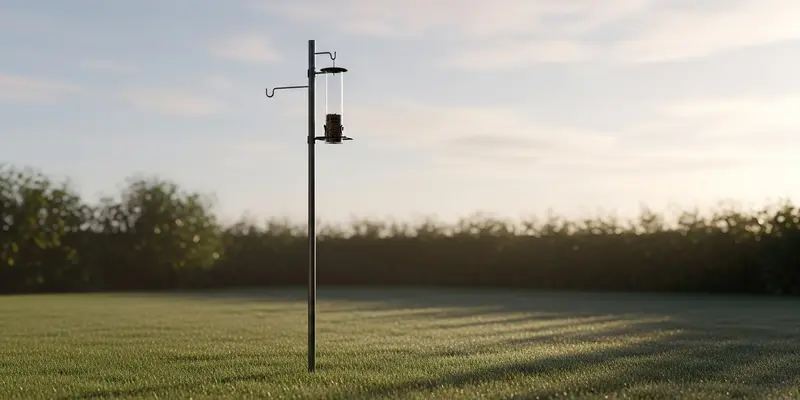
Stop wasting your money. You do not need a high-tech squirrel baffle or a “guaranteed” feeder that costs as much as a nice dinner out. The secret to successful squirrel-proofing is currently sitting in your kitchen pantry, right next to your frying pan. It is cheap, it is effective, and it is humiliating for the squirrels.
Why Commercial Baffles Are a Scam
Most commercial solutions are over-engineered garbage. They are either flimsy plastic that squirrels eventually chew through or complex metal contraptions that require a degree in mechanical engineering to install. They fail because they try to out-think a creature whose entire existence is dedicated to solving puzzles for calories. You cannot outsmart them with plastic, but you can out-friction them.
The Kitchen Pantry Solution
Here is the play: Non-stick cooking spray. I am talking about the basic, store-brand canola or vegetable oil spray. When you apply a thin, even coat to a slick metal pole, you are not just making the climb difficult; you are making it physically impossible.
- It is food-safe: No toxic chemicals in your garden.
- It is invisible: No ugly plastic domes ruining your view.
- It is instant: It takes ten seconds to apply and works the moment it dries.
The Day Barnaby Met His Match
Last June, I was ready to throw my feeders in the trash. I had a squirrel I nicknamed “Barnaby”—a chunky eastern gray with the persistence of a door-to-door salesman. He had cleared every hurdle I threw at him. I watched him leap three feet from a fence and shimmy up my supposedly “squirrel-proof” pole like he was on a casual stroll.
I went into the kitchen, grabbed a can of Pam, and coated the middle three feet of the pole. Five minutes later, Barnaby returned. He hopped onto the base, prepared for his usual ascent, and then… nothing. He slid down like a cartoon character on a banana peel. The look of utter confusion on his twitching face as he hit the grass was the most satisfying thing I have seen in years. He tried three more times before slinking back to the oak tree, defeated. My birds finally ate in peace.
How to Apply It Correctly
Do not drench the pole. You are not deep-frying it. A light misting is all it takes to create a zero-traction zone. Focus on the “climb zone”—the area between two and five feet off the ground where the squirrel gains momentum.
- Wipe the pole down with a damp cloth to remove grit.
- Spray a thin, vertical strip and let it settle.
- Reapply after heavy rain or every two weeks to maintain the “slip.”
FAQs
Is cooking spray harmful to birds? No. Use a food-grade vegetable oil spray. Since birds land directly on the feeder and not the pole, they never even come into contact with it.
Does this work on wooden posts? Rarely. Wood is porous and absorbs the oil quickly. This hack is specifically designed for slick metal or PVC poles.
Will the oil go rancid in the sun? Because you are applying such a thin layer, it usually dries out or washes away long before it becomes an issue with smell or residue.
Can I use WD-40 instead? Absolutely not. WD-40 is a petroleum-based lubricant and is toxic to wildlife. Stick to kitchen-safe vegetable oils.
How often do I need to reapply the spray? Usually once every two weeks, or after a significant rainstorm. It is so cheap and fast that it is barely an inconvenience.
Does this stop ants from reaching the feeder? Yes. Many crawling insects find the oily surface difficult to navigate, providing a secondary layer of protection for your nectar feeders.