
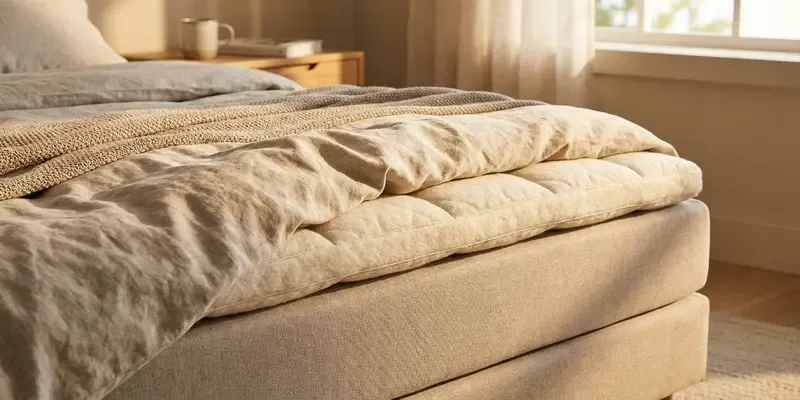
Stop Buying $3k Beds: The $250 Luxury Sleep Hack
Let’s be honest: walking into a mattress showroom is a lot like entering a used car dealership, but with worse lighting and more awkward silence. You lie down on a rectangle of foam that costs as much as a used Honda Civic, and a salesperson in a polyester blend suit hovers over you, asking if you feel “supported.” It’s a racket.
We have been conditioned to believe that quality sleep requires a four-figure investment. We are told that unless we buy the “Cloud-Supreme-Ultra-Pedic,” our spines will crumble by age 40. I am here to tell you that is nonsense.
There is a smarter way to hack the system. It involves ignoring the marketing fluff and understanding the physics of bedding. Today, we are breaking down The $250 Hack to Make a Cheap Mattress Feel Like Luxury.
The Great Mattress Markup
Here is the dirty secret the industry doesn’t want you to know: a $3,000 mattress is usually just a $300 mattress wrapped in $2,700 of marketing and a fancy zippered cover.
Most “luxury” mattresses consist of two main components:
- The Support Layer: A dense foam core or a system of metal coils.
- The Comfort Layer: The soft stuff on top (memory foam, latex, wool).
When a mattress starts to sag or get uncomfortable, it is almost always the comfort layer failing, not the support layer. Yet, when that top three inches wears out, you have to throw the whole expensive thing away. Why buy a monolith when you can build a modular system?
The Strategy: Go Cheap on the Base, Heavy on the Top
The strategy is simple. You buy the firmest, most basic mattress you can find. I’m talking about the rock-hard, no-frills models from IKEA or Amazon Basics. These are essentially just giant blocks of support. They are durable because they lack the soft, fragile foams that break down over time.
Then, you take the money you saved—thousands of dollars—and you spend about $200 to $300 on a top-tier, high-density mattress topper.
This isn’t just about saving money; it’s about customization. You are decoupling the support engine from the comfort interface. If you buy a dedicated topper, you can get higher quality materials (like 5lb density memory foam or 100% natural Talalay latex) than what is glued inside most commercial mattresses.
My $200 Epiphany in a Chicago Walk-Up
I didn’t stumble on this advice by reading a textbook; I learned it through back pain and poverty.
Years ago, I moved into a drafty third-floor walk-up in Chicago. I was fresh out of college, my bank account was hovering near zero, and I needed a bed. I ended up buying a ridiculously cheap, rock-hard spring mattress from a discount furniture warehouse. It cost me $150 and felt like sleeping on a parking lot.
For two weeks, I woke up with bruised hips and a stiff neck. I was miserable. I was ready to put the thing on the curb and sleep on the floor.
Desperate, I scraped together some cash and ordered a 3-inch, high-density memory foam topper online. I didn’t have high hopes. I unrolled it, let it expand, and threw some cheap jersey sheets over it.
That night was a revelation. The cheap springs provided the push-back my spine needed, while the thick foam contoured perfectly to my pressure points. It felt exactly like the $4,000 bed my rich aunt bragged about. I slept on that “Frankenstein” bed for five years, and it was arguably the best sleep of my life. When the topper eventually lost its springiness, I didn’t buy a new bed—I just spent another $150 on a new topper. Problem solved.
How to execute the Hack
Ready to stop burning money? Here is your roadmap.
1. The Base
Buy a “Firm” or “Extra Firm” mattress. Avoid “Pillow tops” or “Hybrids” with built-in fluff. You want a flat, sturdy surface. Innersprings are great for airflow; high-density polyfoam is great for motion isolation.
2. The Topper
This is where you splurge. Do not buy the $40 egg-crate foam from the supermarket. That is garbage.
- Memory Foam (4lb+ density): Best for side sleepers who want that sinking, hugging feeling. Look for “open cell” foam if you sleep hot.
- Latex (Talalay or Dunlop): Best for back sleepers or those who want bounce. It sleeps cooler than foam and lasts longer, but it feels more distinct.
- Thickness: Aim for 3 inches. Two inches often isn’t enough to hide the hardness of the base; four inches can make you feel stuck in quicksand.
3. The Anchor
A common complaint is that toppers slide around. The solution is a fitted mattress protector that goes over both the topper and the mattress, cinching them together into one unit. It keeps the setup looking like a single piece of furniture.
Conclusion
You don’t need to finance your sleep. The industry relies on your ignorance and your fear of a bad night’s rest to upsell you. Take control. Build your own cloud. Your wallet—and your back—will thank you.
FAQs
1. Will the topper slide off the mattress at night?
If you just lay it on top, maybe. But if you use a deep-pocket fitted sheet or a tight mattress protector to encase both the mattress and the topper, it won’t move an inch. Some toppers also come with corner straps specifically for this purpose.
2. Doesn’t memory foam make you sleep hot?
Cheap memory foam does. This is why you invest the $250 savings into high-quality foam with cooling gel infusions or open-cell structure. Alternatively, choose natural Latex, which is naturally breathable and doesn’t trap heat like foam does.
3. How long will this setup last?
A cheap firm mattress can last 10+ years because it has no soft layers to degrade. A high-quality topper usually lasts 3-5 years. The beauty is that replacing the topper is cheap and easy, whereas replacing a sagging luxury mattress is a logistical nightmare.
4. Can I do this with a used mattress?
Absolutely, provided the used mattress isn’t sagging in the middle. If the support springs are broken or dipped, a topper will just follow the dip. The base needs to be flat and supportive for this hack to work.
5. Is Latex or Memory Foam better?
It is subjective. Memory foam absorbs energy and creates a “dead” feel (no bounce), which is great for partners who toss and turn. Latex is springy and pushes back against you, making it easier to roll over and get out of bed.
6. What if the mattress is TOO firm?
That is actually perfect. It is infinitely easier to soften a hard bed with a topper than it is to firm up a soft bed. You can always add comfort, but you cannot add support to a marshmallow.


