
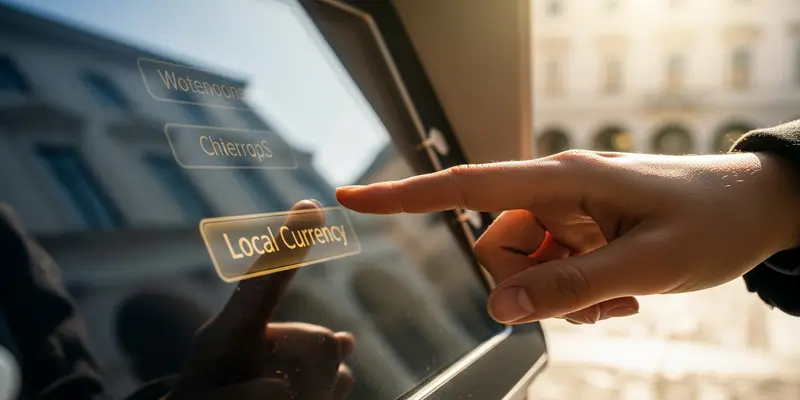
You’re standing in a cobblestone alley in Lisbon. You’re tired, your legs ache from climbing hills, and you just want a few Euros for a pastel de nata. You find an ATM, slide your card in, and then it happens. The screen flashes a polite, helpful-looking question: "Would you like to be charged in your home currency with a guaranteed exchange rate?"
It feels like a safety net. It looks like convenience. In reality, it is a predatory trap designed to siphon 5% to 15% of your money into the bank’s pocket. This is Dynamic Currency Conversion (DCC), and if you want to protect your travel budget, you must learn to say no. Always choose to withdraw without conversion.
The Great Conversion Scam
Banks love to frame DCC as a service. They tell you that by seeing the transaction in Dollars or Pounds, you’ll have "peace of mind." Don’t buy it.
When you accept their conversion, the ATM operator—not your bank—sets the exchange rate. They aren’t using the mid-market rate you see on Google. They are using a bloated, marked-up rate that benefits their bottom line. By choosing to pay in the local currency, you force the transaction back to your home bank. Your bank almost certainly offers a better rate, even if they charge a small foreign transaction fee.
Why Local Currency is Your Best Friend
When you choose to be charged in the local currency (Euros, Yen, Pesos), you are keeping the power.
- Transparency: You get the network rate (Visa/Mastercard).
- Control: Your home bank handles the math, not a random machine in a train station.
- Savings: On a $200 withdrawal, the difference can be as much as $30. That’s a nice dinner gone in a single click.
A Rainy Lesson in Tokyo
I learned this the hard way on a freezing Tuesday night in Shinjuku. I was low on cash and high on exhaustion. I found a 7-Eleven ATM and, when prompted with a screen offering to charge me in USD with a "guaranteed locked-in rate," I clicked ‘Yes.’ I just wanted to get to my hotel.
I felt the plastic keys click under my fingertips. A second later, the receipt spat out. I did the math in my head as I walked back into the neon-soaked rain. I had just paid an effective rate that was 12% higher than the actual market value. I had basically handed the bank the price of three bowls of premium ramen just for the ‘convenience’ of seeing a familiar currency symbol. I felt like a mark. I haven’t clicked ‘Yes’ since.
How to Defeat the Screen
The wording on these machines is intentionally confusing. They will use phrases like:
- "Proceed with conversion" (Choose NO)
- "Decline conversion" (Choose YES)
- "Charge in local currency" (Choose YES)
The goal is to get your money into the machine’s internal conversion system. Always look for the option that keeps the transaction in the currency of the country you are currently standing in. If the machine asks you twice—which some aggressive ones will—stay firm.
Your Strategy for Future Trips
Stop letting travel anxiety cost you money. You don’t need the ATM to do the math for you; you have a smartphone for that.
To truly win at the travel game, pair this knowledge with a card that reimburses ATM fees (like Charles Schwab or Wise). This turns every ATM in the world into your local bank. Travel is about exploring the world, not funding a bank’s quarterly profits. Take the stand, click the right button, and keep your money where it belongs: in your pocket.
FAQs
What is Dynamic Currency Conversion (DCC)?
DCC is a process where a foreign ATM or merchant offers to convert a transaction into your home currency on the spot, usually at a very poor exchange rate.
Why is ‘Withdraw without conversion’ better?
Choosing this option allows your home bank to handle the conversion. Your bank almost always uses a rate much closer to the real market value than the ATM operator.
Does this apply to credit card machines too?
Yes. When a waiter or shopkeeper asks if you want to pay in your home currency, always say "Local currency, please."
Is there ever a time when DCC is cheaper?
Almost never. It is structurally designed to be a profit-generating tool for the merchant and the ATM provider.
What happens if I choose ‘Decline Conversion’?
The transaction still goes through. You will receive your cash in the local currency, and your bank will deduct the equivalent amount from your account later at their standard rate.
How much can I save by avoiding conversion?
Depending on the markup, you can save anywhere from 3% to 15% per transaction. Over a two-week trip, this can easily add up to hundreds of dollars.