
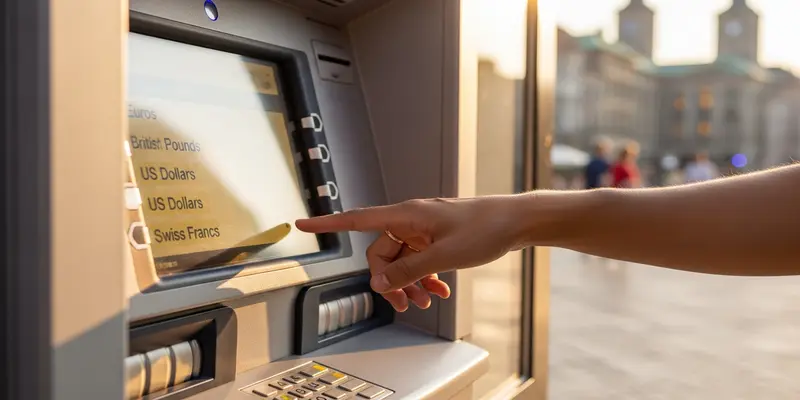
You are standing in a charming square in Florence. You need Euros for a gelato and a leather notebook. You find an ATM, slide in your card, and the screen flashes a friendly, reassuring offer: "Lock in your exchange rate now and avoid market volatility!" It feels safe. It feels certain. It is a calculated trap.
This is the world of Dynamic Currency Conversion (DCC), and it is the single biggest legalized heist in modern travel. If you choose to see the transaction in your home currency, you are volunteering to be robbed.
The Illusion of the "Guaranteed Rate"
Banks love to play on your fear of the unknown. They know you don’t have the current mid-market exchange rate memorized. They present you with a choice: a fixed amount in your home currency (USD, GBP, CAD) or an unknown amount in the local currency.
When you pick your home currency, the ATM provider—not your bank—sets the rate. They don’t use the fair market price. They use a proprietary rate that includes a massive markup, often between 5% and 13%.
The Magic Phrase: "Decline Conversion"
There is only one right answer at an international ATM. You must always select "Withdraw Without Conversion" or "Decline Conversion."
By doing this, you are telling the machine to process the request in the local currency (Euros, Yen, Pesos). This forces the transaction back to your home bank and the Visa/Mastercard network. These networks use the interbank rate, which is the closest you will ever get to the "real" value of money.
- The ATM’s Rate: Designed to maximize profit for the machine owner.
- Your Bank’s Rate: Usually within 1% of the market rate.
- The Result: Choosing local currency keeps $10 to $50 in your pocket per withdrawal.
A Costly Lesson in Shinjuku
I learned this the hard way in Tokyo. I was jet-lagged, starving, and standing at a 7-Eleven ATM in Shinjuku. The machine offered to charge me $550 USD for a 60,000 Yen withdrawal. It sounded fine at the time.
Two days later, I checked my statement. If I had declined the conversion, the cost would have been roughly $495 based on the day’s rate. I had paid a $55 "convenience fee" for a button press. That was a high-end sushi dinner literally thrown into the trash. Now, I never click "Accept" on a conversion, no matter how many warning screens the machine throws at me.
Don’t Let the Warning Screens Scare You
ATMs are programmed to be manipulative. When you decline their conversion, the machine might show a scary pop-up: "We cannot guarantee the exchange rate! Your bank may charge additional fees!"
This is a scare tactic. Your bank’s "hidden" fees are almost certainly lower than the daylight robbery the ATM is trying to pull. Be firm. Be clinical. Press the button that says local currency and walk away with your cash intact.
FAQs
Q: What is Dynamic Currency Conversion (DCC)? A: It is a service where a foreign merchant or ATM offers to convert a transaction into your home currency at the point of sale, usually at a terrible rate.
Q: Why is the ATM’s exchange rate so much worse? A: Because the ATM owner adds a massive profit margin (spread) on top of the real exchange rate, which they keep for themselves.
Q: Does this apply to credit card readers in shops too? A: Absolutely. Always pay in the local currency at restaurants and shops. Never let them charge you in your home currency.
Q: What if the ATM doesn’t give me a choice? A: Some predatory ATMs try to force it. If you don’t see a choice to decline, cancel the transaction and find a machine owned by a major local bank.
Q: Will my bank still charge me a foreign transaction fee? A: Possibly, depending on your bank’s policy. However, you will still save money because you avoided the 10% markup from the ATM’s conversion.
Q: Are there any banks that don’t charge ATM fees at all? A: Yes, banks like Charles Schwab or Betterment in the US often refund all global ATM fees, making them the gold standard for travelers.