
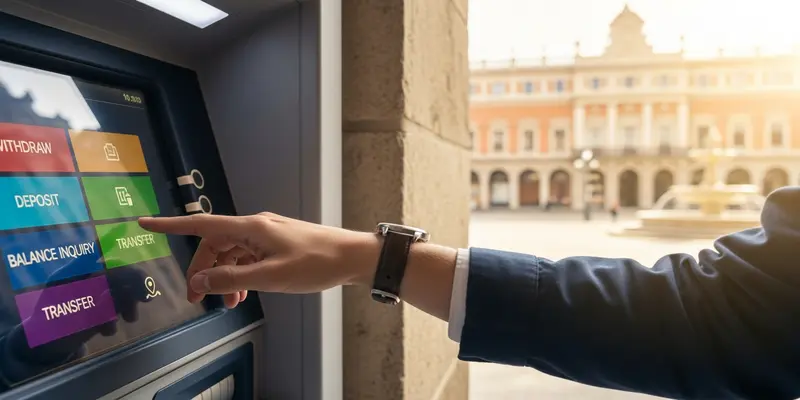
You are standing on a cobblestone street in Lisbon, the scent of sea salt and grilled sardines in the air. You need cash for a small bakery that doesn’t take cards. You find an ATM, insert your card, and the screen presents a polite, almost helpful question: “Would you like to be charged in your home currency?” It shows you a nice, clean number in dollars or pounds. It feels safe. It feels transparent.
It is a total scam.
This predatory tactic is known as Dynamic Currency Conversion (DCC), and it is the single most common way travelers get fleeced at the finish line. If you want to keep your hard-earned money in your pocket instead of donating it to a foreign bank’s profit margin, there is only one rule: Always choose to withdraw without conversion.
The Psychology of the Trap
Banks and ATM operators aren’t stupid. They know that when you are in a foreign country, you are cognitively overloaded. You are calculating distances in kilometers, trying to remember basic phrases, and navigating a new city. They offer you the “convenience” of seeing the transaction in your home currency to exploit your desire for certainty.
When you accept their conversion, you aren’t just paying for the cash; you are paying a massive, hidden markup. These rates are often 5% to 12% worse than the actual market rate. They are betting that you’d rather have the peace of mind of a fixed number than the “risk” of a variable exchange rate. Don’t take the bait.
Why Your Home Bank is Your Best Friend
When you select “Withdraw Without Conversion” or “Decline Conversion,” you are telling the ATM to charge your account in the local currency. This forces your home bank to handle the math.
- Interbank Rates: Your home bank uses the wholesale interbank rate, which is significantly closer to what you see on Google or XE.
- Transparency: Even if your bank charges a small foreign transaction fee, it is almost always lower than the predatory markup of a DCC machine.
- Control: You stay in control of the transaction rather than handing a blank check to a third-party processor.
The Cost of a Lazy Click: A Lesson from Rome
I learned this the hard way in the Trastevere district of Rome. I was exhausted, hungry, and slightly buzzed on cheap Chianti. I needed 200 Euros for dinner. The ATM—a bright yellow-and-blue machine that seemed to be on every corner—offered me a “guaranteed” rate that would charge my US account $245.
I was tired of doing mental math, so I hit “Accept.”
The next morning, I did the calculation. Had I declined the conversion, the mid-market rate would have cost me roughly $218. That single, lazy button press cost me $27. In Rome, $27 is three high-quality pizzas and a bottle of house wine. I didn’t get those pizzas; the bank did. Since then, I have never clicked “Accept” again.
How to Win at the ATM
To ensure you aren’t being overcharged, follow this simple protocol every time you travel:
- Use Bank-Owned ATMs: Avoid standalone machines in convenience stores or tourist traps (like Euronet). Look for ATMs attached to actual banks.
- Read the Screen Carefully: They will use confusing language like “Continue with Conversion” vs. “Continue without Conversion.” Choose the local currency option.
- Carry a Back-up Card: Some cards, like Charles Schwab or Revolut, are designed specifically for travelers and offer even better protection against fees.
Conclusion: Take a Stand for Your Travel Budget
Travel is about discovery, not about being a piggy bank for international financial institutions. By simply paying attention to that final screen and choosing to withdraw without conversion, you protect your budget. Those few dollars saved on every transaction add up to an extra museum entry, a better hotel room, or a memorable meal. Don’t let the machine win. Decline the conversion, keep your cash, and enjoy your journey.
FAQs
1. What is Dynamic Currency Conversion (DCC)? It is a service offered by merchants and ATM operators that allows you to see a transaction in your home currency, but at a heavily marked-up exchange rate.
2. Is it always better to pay in the local currency? Yes. Always. Whether you are at an ATM or a restaurant card terminal, always choose the local currency (e.g., Euros in France, Yen in Japan).
3. Will my bank charge me a fee for declining conversion? Your bank may charge a standard foreign transaction fee, but this is almost always significantly cheaper than the 5-12% markup applied by DCC.
4. Why do ATMs make ‘Decline’ look like the wrong choice? They use “dark patterns”—visual designs intended to trick you into clicking the more profitable option for them. They might use red text for “Decline” to make it look like a warning.
5. What if the ATM doesn’t give me a choice? If an ATM forces a conversion without asking, cancel the transaction and find a different machine. This is rare but does happen with some predatory operators.
6. How can I see the ‘real’ exchange rate? Use an app like XE Currency or simply search “100 EUR to USD” on Google to see the current mid-market rate before you head to the ATM.