
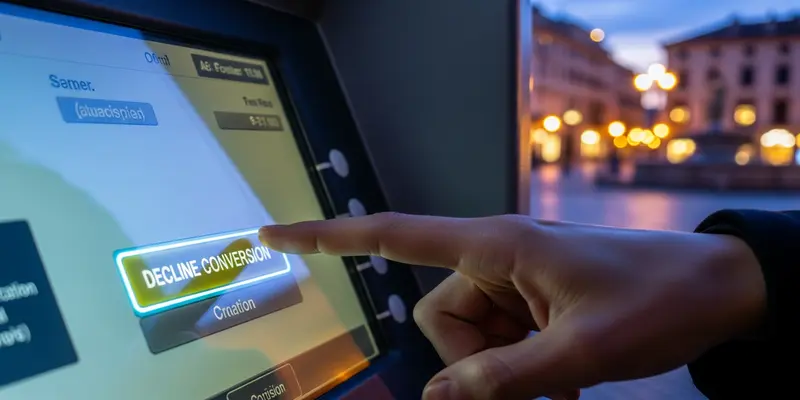
You’re standing in a rain-slicked plaza in Prague, the smell of spiced trdelník in the air, and you need a few hundred Koruna. You slide your card into a glowing terminal, and suddenly, the machine asks a high-stakes question: “Would you like to be charged in your home currency for your convenience?” It sounds helpful. It sounds safe. It is, in fact, one of the most effective ATM Traps in the travel world.
The Psychology of the Scam
Banks and ATM providers know you’re tired. They know you’re doing mental math at a chaotic intersection in a city where you don’t speak the language. Dynamic Currency Conversion (DCC) is a predatory feature disguised as a service, specifically designed to exploit that momentary travel fatigue.
When an ATM offers to “lock in” an exchange rate, they aren’t doing you a favor. They are charging you for the “privilege” of using a terrible, marked-up rate. You aren’t paying for convenience; you are paying a laziness tax that can easily reach 10% to 15% of your total withdrawal. It is a legalized heist performed on a digital screen.
Why “Decline Conversion” is the Only Way
Here is the golden rule of international travel: Always let your home bank do the math. Trust the institution that actually wants to keep your business, not the random terminal in a tourist trap.
- The Interbank Rate: Your card issuer (Visa or Mastercard) uses the interbank rate, which is the gold standard for exchange values.
- Transparency: When you choose “Withdraw without conversion,” the ATM processes the request in the local currency. Your bank statement then reflects a fair, market-driven conversion.
- The Hidden Markup: DCC rates include massive hidden fees that the ATM provider pockets. They rely on your fear of “fluctuating rates” to scare you into their trap.
A Costly Lesson in Mexico City
I remember my first night in Mexico City years ago. I was starving, eyeing a taco stand that smelled like heaven, and I hit a local ATM. The screen flashed a “Guaranteed Exchange Rate” of 17 pesos to the dollar, while the actual market rate was nearly 20. It warned me that I “could face unknown fees” if I declined.
I felt the pressure. The line behind me was growing. My thumb hovered over “Accept.” Luckily, I stopped and hit “Decline.” By choosing the local currency and letting my bank handle the conversion, I saved $42 on a $300 withdrawal. That isn’t just pocket change—that’s a high-end dinner at a Michelin-starred spot in Polanco. I would have literally handed that money to a bank for no reason other than fear.
How to Spot the Trap
ATM providers are clever. They use “dark patterns” in their software to trick you. Look out for these specific phrases on the screen:
- “Continue with conversion”
- “Lock in this rate”
- “Fixed exchange rate”
- “Charged in [Your Home Currency]”
If you see these, look for the “Decline” or “Withdraw in Local Currency” button. It is often smaller, less colorful, or tucked away in a corner. They don’t want you to find it because every time you do, they lose a massive profit margin.
Conclusion: Take Control of Your Cash
Travel is about freedom, not about being a piggy bank for foreign ATM networks. By understanding these ATM Traps, you keep your hard-earned money where it belongs—in your pocket for the next adventure. Next time the screen asks if you want “convenience,” say no. Your bank account will thank you.
FAQs
What exactly is Dynamic Currency Conversion (DCC)?
It is a process where a foreign merchant or ATM offers to convert a transaction into your home currency at the point of sale, usually at an extremely poor rate.
Is it ever better to choose the ATM’s conversion rate?
Almost never. The rate offered by the ATM is designed to generate profit for the terminal owner. Your home bank will almost always offer a significantly better rate.
What happens if I choose “Without Conversion”?
The ATM processes the request in the local currency (e.g., Euros or Yen). Your home bank then converts that amount to your home currency using their standard, fair market rates.
Does this apply to credit card machines in shops?
Yes. If a waiter or shopkeeper asks if you want to pay in your home currency instead of the local one, always insist on the local currency.
What if the ATM doesn’t give me a choice?
Most reputable banks are required to offer a choice. If a machine forces a conversion without an opt-out, cancel the transaction and find a different bank’s ATM.
How much money can I actually lose to these traps?
DCC markups typically range from 5% to 15%. On a $500 withdrawal, you could be throwing away up to $75 just for pressing the wrong button.