
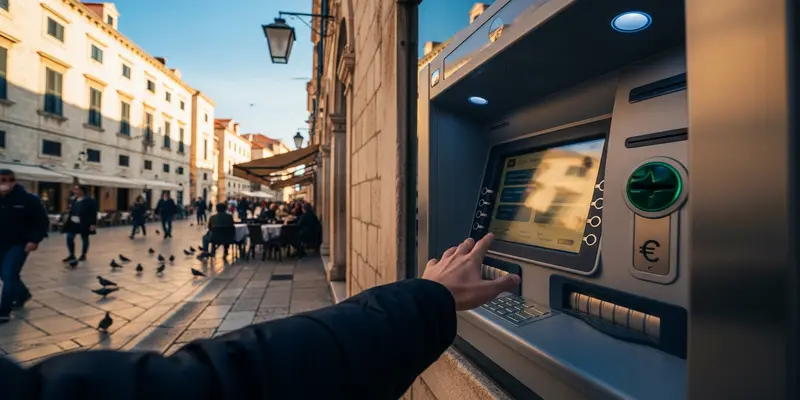
You’re standing in a humid airport terminal after a ten-hour flight. Your brain is fogged, your back is stiff, and all you want is enough cash to pay for a taxi. You slide your card into the machine, and a polite screen pops up with a seemingly helpful offer: "Would you like to be charged in your home currency for a guaranteed rate?"
Stop right there. This is the ATM Currency Conversion Trap, and it is designed to bleed your travel budget dry before you’ve even left the airport.
The Illusion of Convenience
The banking industry calls this "Dynamic Currency Conversion" (DCC). I call it a legal mugging. The machine presents you with two choices. One looks safe (your home currency) and the other looks uncertain (the local currency).
Psychologically, we crave certainty. We like seeing a familiar dollar or pound sign. But that certainty comes at a premium—often between 5% and 13% above the mid-market exchange rate.
- The Trap: The ATM owner sets the exchange rate.
- The Reality: Your home bank almost always offers a better rate.
- The Rule: If the ATM asks to do the math for you, say no.
Why Your Bank is the Better Partner
When you choose to "Withdraw Without Conversion," you are telling the foreign ATM to just send the request for local currency to your home bank. Your bank then converts that amount using the interbank rate, which is the gold standard of exchange.
Even if your bank charges a small foreign transaction fee, it will rarely equal the predatory margins added by the ATM’s DCC software. You are effectively paying for a service you don’t need.
A Lesson Learned in Lisbon
I remember standing at a bright blue Euronet ATM in Lisbon’s Chiado district. I needed 100 Euros. The machine offered to charge my US bank account $118, claiming it was a "zero percent commission" service.
I smelled the rot. I declined the conversion and let my bank handle the dirty work. When I checked my statement later, I had been charged exactly $106.50. That two-second decision saved me $11.50—the price of two glasses of Vinho Verde and a plate of grilled sardines. I’ve seen travelers lose hundreds over the course of a two-week trip simply because they were too tired to hit the "Decline" button.
How to Fight Back
To keep your money where it belongs, follow these non-negotiable rules for international travel:
- Always Choose Local Currency: Whether it’s Pesos, Yen, or Euros, stay in the local lane.
- Avoid ‘Independent’ ATMs: Machines in convenience stores or kiosks (like Euronet) have the worst rates. Stick to official bank ATMs.
- Check Your Card Benefits: Use a card that reimburses ATM fees (like Schwab or Revolut).
- Read Carefully: Sometimes the button says "Accept Conversion" (Bad) vs "Decline Conversion" (Good). Don’t just click the green button out of habit.
The Final Word
Travel is about discovery, not about being a passive profit center for foreign banks. The next time a screen tries to sell you on a "guaranteed rate," remember that the only thing they are guaranteeing is that you’ll be poorer for the privilege. Choose the local currency, keep your math skills sharp, and spend that saved cash on an extra night out.
FAQs
Q: What is Dynamic Currency Conversion (DCC)? A: It’s a process where a foreign ATM or merchant offers to convert a transaction into your home currency on the spot, usually at a terrible rate.
Q: Is it ever better to accept the ATM’s conversion? A: Almost never. The only rare exception is if your home bank has astronomical, flat-rate foreign fees and you are withdrawing a very small amount, but even then, it’s unlikely.
Q: What happens if I hit ‘Decline Conversion’? A: The transaction still goes through. You get your cash, but the conversion is handled by your home bank at a much fairer rate.
Q: Do credit card machines at restaurants do this too? A: Yes. If a waiter brings a terminal and asks if you want to pay in USD or the local currency, always choose the local currency.
Q: Why do ATMs offer this if it’s bad for customers? A: Because it’s highly profitable. The ATM operator and the local bank split the margin they make on the inflated exchange rate.
Q: How can I tell if an ATM is a ’trap’ machine? A: Independent ATMs in high-tourist areas are the biggest culprits. Look for ATMs attached to actual physical bank branches for the best experience.