
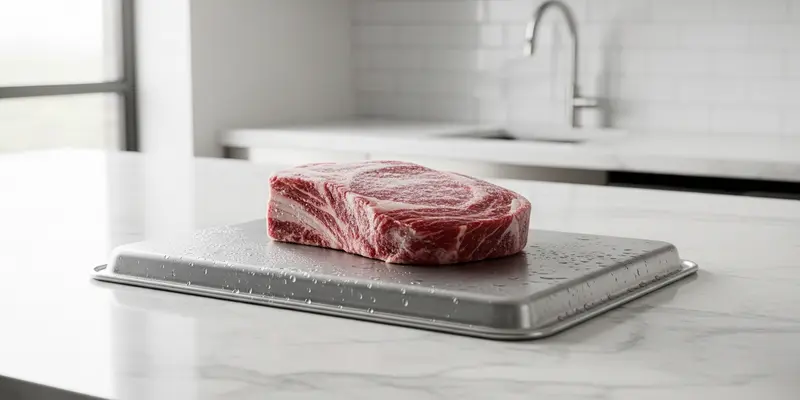
It is 6:00 PM on a Tuesday. You are hungry, tired, and your main course is currently a solid block of ice. We have all been there, staring at a frozen chicken breast like it is a personal betrayal. Most people reach for the microwave, but that is a mistake that leads to rubbery edges and a frozen core.
There is a better way. A recent Reddit discovery has highlighted a trick professional chefs have used for decades: the aluminum heat sink hack. It is simple, it is free, and it relies on pure physics rather than unreliable electronics.
Why Aluminum is Your Best Friend
Air is a terrible conductor of heat. When you leave meat on a wooden cutting board at room temperature, it thaws slowly because the air around it acts like an insulator. Aluminum, however, is a thermal powerhouse. It pulls heat from the surrounding environment and rams it into your food with aggressive efficiency.
By placing your frozen meat on an upside-down aluminum tray, you are creating a massive surface area for heat exchange. The tray acts as a “heat sink” in reverse. It absorbs the ambient warmth of your kitchen and transfers it directly into the frozen proteins.
How to Execute the Hack Perfectly
To get the best results, you cannot just throw a steak on a pan and walk away. Follow these steps to shave an hour or more off your wait time:
- Flip the Tray: Use a standard aluminum rimmed baking sheet. Turn it upside down so the flat bottom is facing up. This allows for better airflow underneath the metal.
- Surface Contact is King: Ensure your meat is in a flat, thin freezer bag. Any air pockets inside the bag will act as insulation and slow the process down.
- The Sandwich Method: If you want to go pro, place the meat on one inverted tray and set a second aluminum tray on top of the meat. This doubles the surface area and thaws both sides simultaneously.
The Night I Almost Ruined the Ribeye
I remember hosting my first real dinner party in a cramped apartment three years ago. I had spent fifty dollars on a prime ribeye, only to realize at 5:30 PM that it was still a brick. I panicked. I could feel the cold condensation on the plastic, and the clock was ticking.
I grabbed two old aluminum pizza pans. I sandwiched that steak between them and weighted the top pan with a cast-iron skillet to ensure total contact. Every ten minutes, I checked. I could literally feel the cold being sucked out of the meat and into the metal. In twenty-five minutes, that steak was supple, red, and ready for the sear. It was the best meal I ever served, saved entirely by a basic understanding of thermal conductivity.
Safety First: Don’t Leave it Out Too Long
While this hack is fast, you still need to be smart. You are using room-temperature air to do the heavy lifting. The goal is to get the meat to a cookable state, not to let it reach room temperature.
As soon as the meat is pliable, get it in the pan or back in the fridge. Bacteria love the “danger zone” between 40°F and 140°F. Because this method works so quickly—usually 20 to 40 minutes for most cuts—it is significantly safer than letting meat sit on a counter for four hours.
Stop Overcomplicating Your Kitchen
We live in an age of expensive gadgets and “smart” appliances that usually just break. Sometimes, the best solution is the one that has been sitting in your cupboard the whole time. The aluminum tray hack isn’t just a trick; it’s a testament to the power of simple science. Stop waiting for your dinner. Flip a tray, drop the meat, and start cooking.
FAQs
Q: Does it have to be aluminum? A: Yes. While other metals conduct heat, aluminum is exceptionally efficient and lightweight, making it the ideal material for this specific thermal transfer.
Q: Can I use a stainless steel tray? A: You can, but it will be much slower. Stainless steel has much lower thermal conductivity than aluminum. If you have the choice, always go with aluminum.
Q: How long does it usually take? A: For a standard one-inch thick steak or chicken breast, you are looking at 20-30 minutes. Thicker cuts may take up to 45 minutes.
Q: Do I need to flip the meat? A: If you are using the “sandwich” method (one tray on top, one on bottom), you don’t need to flip. If you only have one tray, flip the meat every 10 minutes for even results.
Q: Is this better than thawing in water? A: Thawing in a cold water bath is also effective, but the tray hack is less messy and doesn’t risk water leaking into your bag and ruining the texture of the meat.
Q: Can I use this for frozen vegetables? A: It works, but because vegetables are less dense than meat and often come in odd shapes, the contact area is smaller, making it less effective than it is for proteins.