
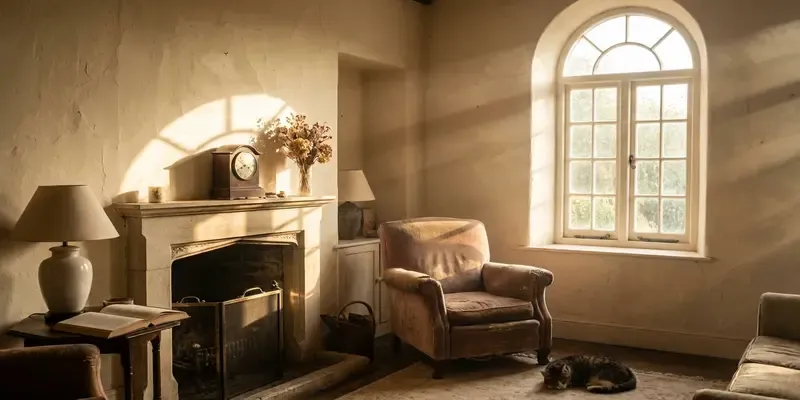
Why Plaster Walls Save Sanity: The 1900s Secret
Picture this: It is 7:00 AM on a Saturday. The cartoons are blaring. The blender is grinding frozen fruit. Your toddler is currently auditing the structural integrity of a plastic fire truck against the hardwood floor. In a modern, open-concept home, this acoustic violence travels unimpeded from the kitchen to the master bedroom. There is no escape.
We have been sold a lie about modern living. We were told that tearing down walls would bring families together. Instead, it just amplified the chaos. If you value your mental health, you need to look backward. This is Why Parents Should Buy 1900s Homes: The Acoustic Secret of Plaster Walls.
The Paper-Thin Lie of Modern Drywall
Let’s be brutally honest about modern construction. Standard drywall is essentially chalk sandwiched between two pieces of thick paper. It is cheap, it is fast to install, and acoustically speaking, it is garbage.
When a builder throws up a half-inch sheet of drywall on hollow studs, they are building a drum, not a wall. Sound waves hit that surface and vibrate right through to the other side. In an open-concept layout, you don’t even have the drywall to stop the noise; sound simply bounces off hard countertops and glass windows until your living room sounds like a high school cafeteria.
The Fortress of Lathe and Plaster
If you walk into a home built before 1950, the air feels different. It feels heavy. Still. That is the density of history, but it is also the density of materials.
Lathe and plaster walls are not just “walls.” They are an engineering marvel of layers:
- The Lathe: Horizontal strips of wood nailed across the studs.
- The Scratch Coat: A rough mixture of plaster (and often horsehair for binding) squished through the wood strips to create a “key.”
- The Brown Coat: A second layer to level the surface.
- The Finish Coat: The smooth, hard white layer you see.
This isn’t a partition; it is a shield. The sheer mass of these walls absorbs sound energy rather than transmitting it. The irregular internal structure breaks up sound waves. When you buy a 1900s home, you are buying built-in noise cancellation.
A Tale of Two Houses
I need to tell you about the moment I became a believer. Years ago, I visited a friend in his brand-new, half-million-dollar “luxury” tract home. We were sitting in his home office, trying to have a conversation. His five-year-old was watching TV in the living room—three rooms away. I could hear every word of Paw Patrol. I could hear the dishwasher running. I could hear his wife walking on the floor above us. The house felt like a cardboard box.
Contrast that with the first night I spent in my 1920s Craftsman bungalow. My newborn had colic. He had lungs that could shatter glass. I remember pacing the hallway with him at 3:00 AM, screaming his head off. My partner was in the bedroom, behind a solid wood door and a thick plaster wall.
When I finally got the baby down and crept into bed, I whispered, “I’m so sorry about the noise.” She rolled over, bleary-eyed, and asked, “What noise?” She hadn’t heard a thing. That plaster wall didn’t just block sound; it saved our marriage.
Separation is Sanity
We need to stop demonizing doors. The open-concept trend suggests that a family must be in visual and auditory contact 24/7 to be “connected.” That is nonsense.
To raise children with patience, you need the ability to retreat. You need a space where you can read a book or work without hearing the Minecraft soundtrack. Old homes provide distinct rooms. They offer boundaries. A 1910 Victorian allows you to be a family when you want to, and an individual when you need to.
Conclusion: Embrace the Cracks
People are scared of old houses. They worry about the wiring (fair point) or the lack of closet space (also fair). But they overlook the quality of life that comes with silence.
Yes, plaster might crack. Yes, hanging a picture requires a masonry bit and some patience. But the trade-off is a home that feels like a sanctuary rather than a subway station. If you are a parent on the brink of sensory overload, stop looking at new builds. Go find a dusty old lady of a house built in 1920. Your ears will thank you.
FAQs
1. Does plaster really block sound better than drywall?
Absolutely. The difference is mass and density. Plaster walls are significantly thicker and heavier than drywall, which stops airborne sound waves from passing through. They act as a sound barrier, whereas drywall often acts as a sound membrane.
2. Is it hard to maintain plaster walls in old homes?
It requires a different mindset. You don’t just patch it with spackle. When plaster cracks (and it will), you need to stabilize it with washers or specialized adhesive systems. However, a well-maintained plaster wall can last centuries, unlike drywall which is easily dented.
3. Does Wi-Fi work through lathe and plaster walls?
This is the one downside. The metal mesh (in later plaster) or the sheer density of the masonry can kill Wi-Fi signals. You will likely need a mesh network system with individual nodes in different rooms to get good coverage in a pre-1950s home.
4. Can I insulate lathe and plaster walls?
It is difficult. Because there is no easy access to the stud bay, you usually have to drill holes and blow in cellulose insulation. However, be careful—old houses need to “breathe,” and improper insulation can cause moisture to get trapped in the wood lathe, leading to rot.
5. Is it safe to drill into plaster to hang a TV?
It is safe if you know what you are doing. You must find the stud (which can be tricky with magnetic finders due to the lathe nails). You should pre-drill carefully to avoid cracking the surrounding plaster. Do not use standard drywall anchors; use toggle bolts or hit the stud directly.
6. Do plaster walls contain asbestos?
They can. While plaster itself is usually lime, sand, and gypsum, asbestos was sometimes added as a binder in the mid-20th century (1940s-1970s). In a 1900s home, you are more likely to find horsehair, but if you plan on demolishing a wall, always get it tested first.


